
Key Takeaways:
- Start with a specific public service outcome, then determine whether AI is the right tool to achieve it.
- Build controls around how AI will be used, including data access, human review, and the actions the technology is authorized to take.
- Measure AI’s impact on staff effort, cost, quality, and resident service, and document the evidence behind decisions to continue, change, expand, or stop its use.
—
An AI tool can draft a response in seconds. But for state and local governments, the real test is what happens next: Does the employee reviewing the AI-generated response spend less time on routine work? Does a resident receive an accurate, useful answer sooner? And does the resident have a clear way to reach a person if the AI response isn’t what they need?
That is the difference between generating output and improving public service.
Artificial intelligence is moving quickly from experimentation into government operations. The National Association of State Chief Information Officers (NASCIO) ranked artificial intelligence — including generative AI and agentic AI — as the number-one priority for state CIOs in 2026, ahead of cybersecurity and risk management.
For state and local government leaders, the opportunity is not simply to adopt AI. It’s to identify where the technology can create measurable value while maintaining the controls and accountability residents expect.
The Control to Value approach connects AI investment to a specific public service outcome, the controls needed to support it, and evidence showing whether it is working.
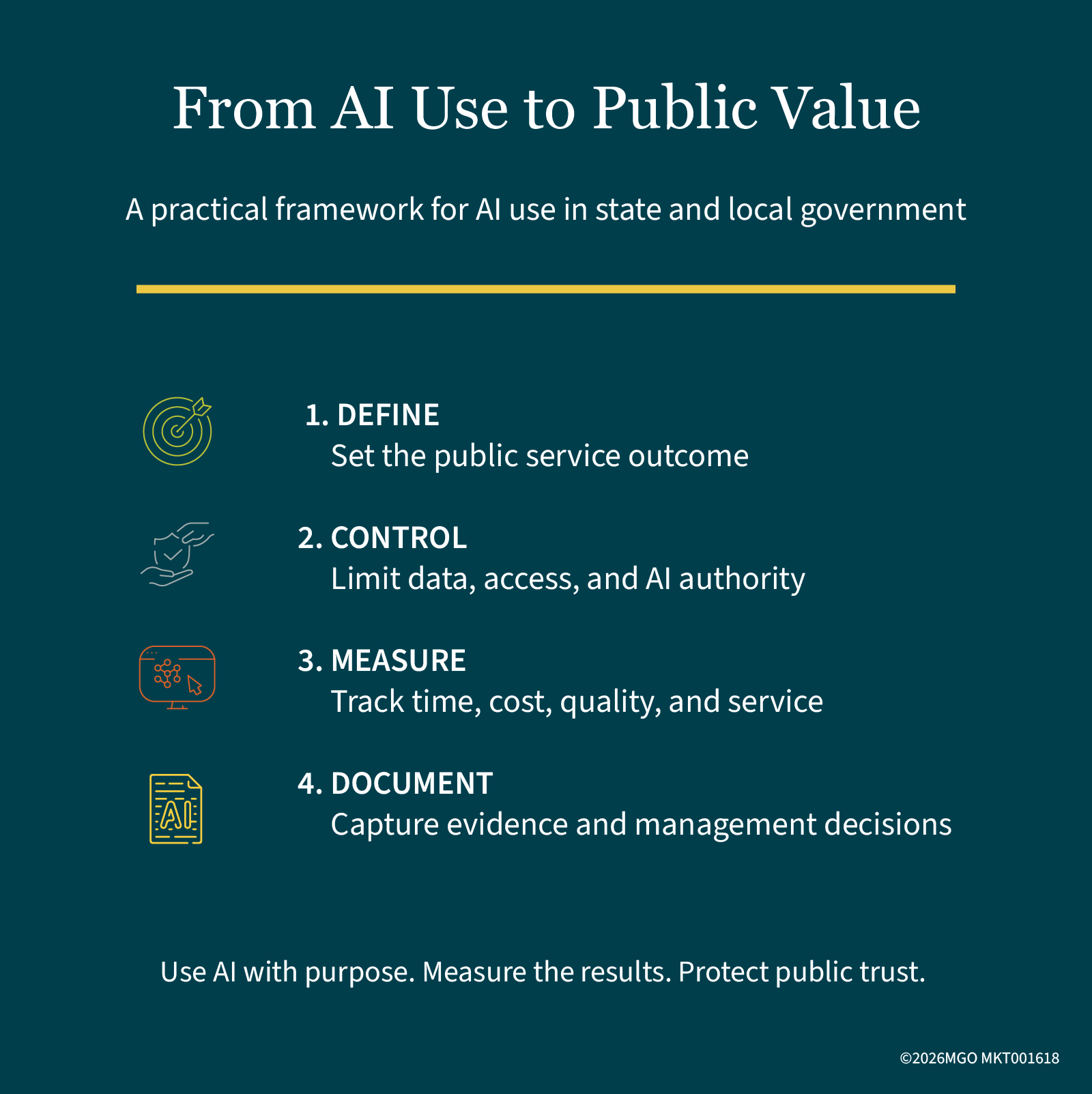
Start With the Service You Want to Improve
The strongest AI use cases start with a recognizable problem — not a technology looking for a purpose.
Maybe employees spend too much time searching for current policies. Residents receive inconsistent answers to routine questions. A grants team spends hours organizing reporting requirements. Or managers need better ways to sort and summarize information before making decisions.
Start by defining what should improve. Potential uses might include:
- Helping employees find approved policies and guidance
- Preparing first drafts of routine correspondence for employee review
- Organizing service requests so staff can prioritize follow-up
- Turning lengthy reporting requirements into draft checklists
- Summarizing information for managers before a decision is made
The right use depends on the information involved and the consequences of an error. An internal tool that helps an employee locate an approved policy presents different risks from an AI system that influences eligibility for a public benefit.
Before investing in a new tool, consider whether AI is even the simplest answer. Better document management, clearer procedures, or capabilities already available in your existing software may solve the problem with less cost and risk.
Then define how the improvement should affect staff and residents. If AI helps draft routine service responses, for example, you might measure response time, correction rates, and repeat contacts. Faster responses are not necessarily better service if residents must contact your agency again because the information was incomplete.
Build Controls Around the Use Case
Once you know what you want AI to accomplish, design controls around that specific use.
AI adoption can introduce risks involving data security, inaccurate or incomplete information, unauthorized access, compliance, and accountability. The nature and severity of those risks depend on what the AI system can access, what it produces, and what happens as a result. Understanding the risks of AI adoption can help you identify where additional safeguards may be needed.
For a policy assistant, for example, you could:
- Limit its source material to approved, current documents
- Assign an owner to maintain those sources
- Require citations or references that employees can verify
- Restrict access based on employee roles
- Establish a process for unanswered or unsupported questions
Set acceptable criteria before testing the tool against known questions, exceptions, and edge cases
Test the controls. Confirm that unauthorized users are blocked and cited sources support the answers. Retain the results.
The National Institute of Standards and Technology (NIST) AI Risk Management Framework offers a useful foundation for evaluating these considerations, including whether an AI system is reliable, secure, transparent, accountable, and appropriate for its intended use.
Data handling deserves the same attention. Before employees enter sensitive information into an AI tool, confirm which tools and data uses your government permits. Involve IT, security, procurement, records, and other relevant teams in understanding how the provider uses, retains, and protects government information.
A familiar software platform’s new AI feature deserves that review, too.
Make Human Review Part of the Process
“Human oversight” only works when someone has the time, information, and authority to actually review the AI output.
Define what the reviewer is responsible for checking and when an output needs to be corrected or escalated. For a draft response to a resident, that might include:
- Whether the correct policy applies
- Whether the information is accurate
- Whether important exceptions are addressed
- Whether the response is clear and understandable
- Whether the resident knows what to do next
Reviewers should be able to correct the output and flag recurring problems. Managers also need to account for review time when setting productivity expectations.
It is equally important to define what the AI tool is not authorized to do.
A tool approved to prepare a draft should not automatically have permission to send the communication, change an official record, approve an application, or initiate another action. As the consequences of an AI-supported action increase, the level of review and approval should increase with them.
Measure the Value, Not Just the Speed
AI can make one task faster without making the overall process more efficient.
Establish a baseline before you implement a new use. Depending on the process, that could include:
- Time required to complete the task
- Volume and backlog
- Correction or rework rates
- Quality measures
- Staff effort
- Total cost, including implementation, licenses, training, and ongoing support
Then measure the entire process, including AI preparation, human review, corrections, and exceptions.
A tool that produces a draft in two minutes may not save time if an employee needs 15 minutes to verify every answer. Likewise, an AI implementation should not be considered a budget savings simply because employees have more capacity. If the recovered time is redirected to grant monitoring, resident assistance, or other work, that is a capacity benefit. A claim of budget savings requires evidence of lower spending attributable to AI; report avoided future costs separately.
The same principle applies to public value. Measure whether the technology changes the service residents experience — not just how often employees use the tool.
The U.S. Government Accountability Office (GAO) AI Accountability Framework emphasizes four areas that are particularly useful here: governance, data, performance, and monitoring. The framework calls for organizations to establish clear goals, assess performance against those goals, and continue monitoring AI systems over time.
Keep Public Trust in the Process
For residents, trust is built through the service they receive.
They need information that is understandable and consistent, along with a practical way to reach someone who can correct an error. If AI interacts directly with the public, explain its role in plain language and provide an accessible path to human assistance.
You should also retain enough evidence to explain significant AI-supported actions, consistent with your privacy and records requirements. Depending on the use case, that could include the source information, AI-generated output, reviewer action, and rationale for the final decision.
And don’t treat implementation as the end of oversight.
Review the system when policies or source documents change. Monitor recurring errors and complaints. Reassess the tool when its capabilities change. If the system becomes unreliable, have a process for pausing its use while continuing to provide the underlying service through another channel.
Create an AI Decision File
You don’t need a complicated governance process for every AI experiment. But before expanding an AI use across your organization, you should be able to answer a few basic questions: What are we trying to improve? What are we allowing the AI to do? What evidence shows that it works? And what are we going to do with the results?
An AI Decision File can provide a simple way to organize that information. Think of it as a living record that follows an AI use case from initial testing through management’s decision to continue, change, expand, or stop it. At a minimum, document the following:
| Document | What to Record |
| Service Objective | The problem, accountable owner, baseline, and intended benefit |
| Authorized Use | Permitted data and actions, review requirements, and limits |
| Evidence | Testing period, acceptance criteria, results, supporting documentation, and unresolved gaps |
| Public Value | Quality, cost, time saved after review and rework, capacity redeployed, and service improvement |
| Management Decision | Whether to continue, change, expand, or stop the use — and why; conditions and follow-up owners |
| Next Review | Review date and conditions that would trigger an earlier reassessment |
Treat gaps as actions to resolve: Assign an owner, a due date, and any limits on use. Without review-time data, for example, faster drafting alone does not demonstrate an efficiency gain.
How MGO Can Help
AI can create meaningful opportunities for state and local governments to improve efficiency and service delivery. But capturing that value requires more than selecting a tool. You need a clear objective, appropriate controls, reliable evidence, and a way to determine whether the results justify continued use.
MGO’s AI Control to Value approach helps connect those pieces. Our IT risk professionals can help you evaluate AI use cases, identify control and evidence gaps, establish practical performance measures, and assess whether your controls are working as intended.
Contact our team today to assess your AI controls and strengthen your approach to AI use.