
This article was co-authored by Taylor Heininger, Co-Founder and President of Cloud Capital Management.
Key Takeaways:
- A successful business exit involves more than negotiating the best deal — it requires preparing for the financial transition that follows.
- Many of the most valuable tax, transaction, and wealth planning opportunities are only available before a sale is underway.
- Coordinating your business, tax, and wealth strategies early can help you preserve more of what you’ve built and prepare confidently for what’s next.
—
For many closely held business owners, selling a company is the largest liquidity event of their lives. But while much of the focus is on completing the transaction, what comes after may be just as important. Once the sale closes, you’re no longer managing a business as your primary asset — you’re managing the wealth it created. That’s a fundamentally different responsibility, and one that requires a different kind of planning.
Most owners spend years increasing the value of their company, improving operations, and positioning the business for a successful sale. Far fewer spend the same amount of time preparing for what happens after the transaction. But that’s often when some of the most important financial decisions begin.
Preparing for an exit isn’t simply about maximizing purchase price. It’s about making decisions before, during, and after a transaction that support the life you want to build once you’ve stepped away from the business.
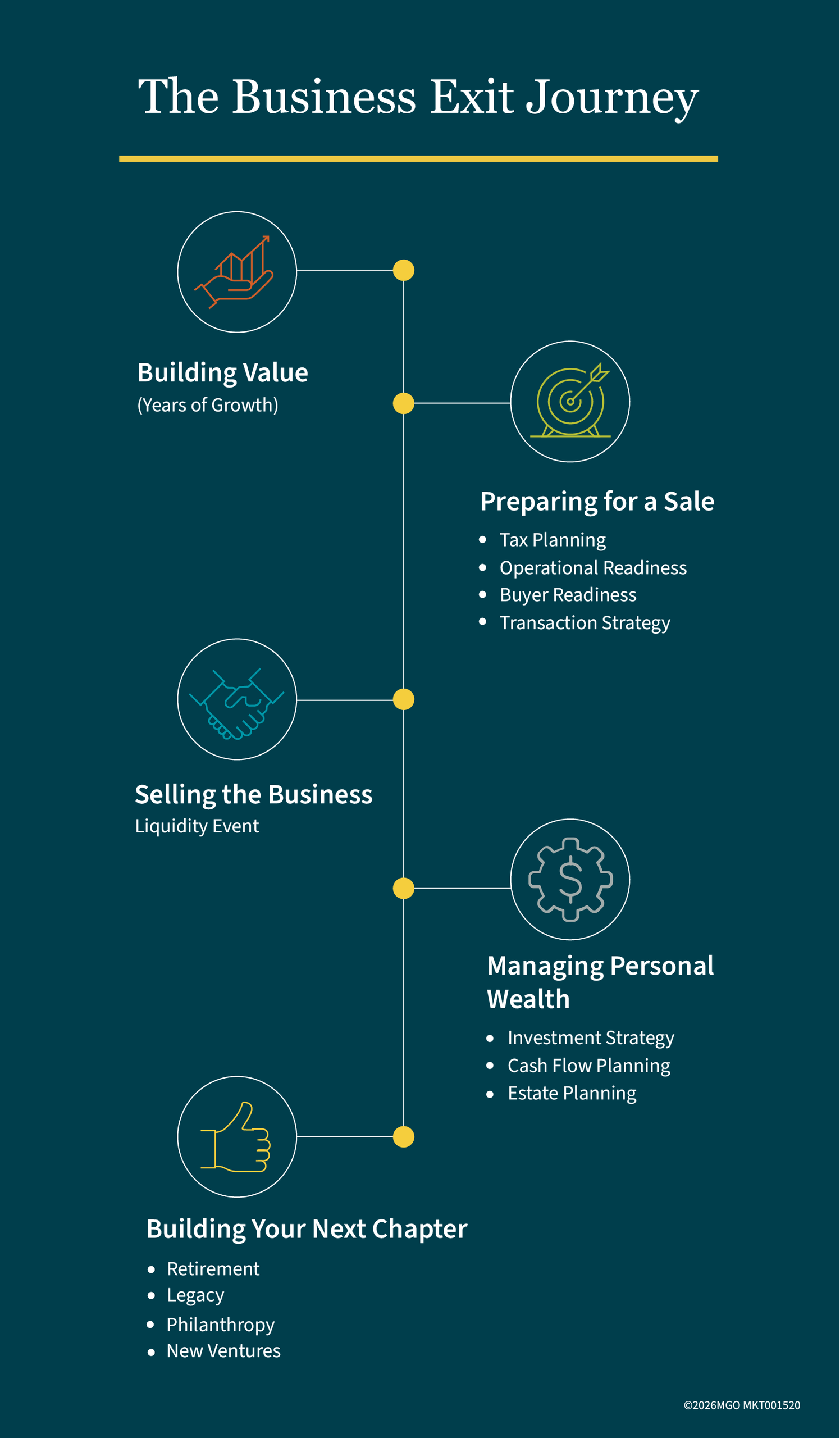
The Founder’s Paradox
Throughout your career, your business has likely been your largest investment — but it hasn’t behaved like an investment portfolio. It’s been an active asset that you’ve influenced every day. You’ve hired employees, invested in growth, solved problems, navigated uncertainty, and made decisions that directly affected its value.
After a sale, that changes. Instead of owning an operating business, you’re managing personal wealth. Your financial future is now shaped by taxes, investment decisions, market conditions, inflation, and cash flow planning rather than the day-to-day decisions you make as an owner.
The skills that helped you build your company aren’t necessarily the same ones required to manage the wealth it creates. Recognizing that shift is one of the first steps toward preparing for a successful exit.
Why Planning Early Creates More Options
Many owners begin thinking seriously about exit planning only after receiving interest from a buyer or entering negotiations. Unfortunately, that’s also when some of the most valuable planning opportunities begin to disappear.
Time is one of your most valuable planning assets. Certain tax, estate, and transaction strategies require months — or even years — to implement effectively. Others become significantly more difficult — or disappear altogether — once negotiations begin or a letter of intent has been signed.
Starting early gives you the opportunity to strengthen both your business and your personal financial position before timing becomes a constraint. Rather than reacting to a transaction, you can prepare for it.
What Should Business Owners Do Before Selling a Business? Six Important Steps
Before pursuing a sale:
- Evaluate your entity structure and transaction strategy.
- Review tax planning opportunities that may only be available before negotiations begin.
- Strengthen financial reporting, operational processes, and documentation to support buyer due diligence.
- Coordinate estate, gifting, and wealth transfer planning.
- Define your long-term income needs and personal financial goals.
- Bring together your tax, legal, transaction, and wealth advisors to develop a coordinated strategy.
These steps don’t guarantee a higher purchase price — but they can significantly expand your options and improve your ability to make informed decisions throughout the process.
The Cost of Waiting
Consider two business owners who sell similar companies for similar purchase prices:
- Owner A: Begins working with advisors several years before the sale. Together, they evaluate tax strategies, improve buyer readiness, coordinate estate planning, and define a long-term financial strategy before negotiations begin.
- Owner B: Waits until an offer is on the table, limiting the planning opportunities available before the transaction moves forward.
Both owners complete the sale. The difference may not be reflected in the purchase price. It may be reflected in after-tax proceeds, estate planning flexibility, wealth transfer opportunities, and the number of strategic choices available before the transaction becomes irreversible.
Your Financial Risks Don’t End at Closing
Receiving a substantial payment from the sale of your business can create a false sense of financial security. But liquid wealth behaves differently than an operating company. Your business generated value because you actively led it. After a sale, your capital must now support retirement, family needs, future business ventures, charitable giving, healthcare expenses, and potentially decades of future lifestyle goals.
Without a coordinated strategy, it’s easy to erode a lifetime of work through avoidable taxes, fragmented planning, or investment decisions that don’t align with your long-term objectives.
The goal isn’t merely to preserve capital — it’s to transform the value you’ve created through your business into a sustainable source of long-term financial flexibility.
Your Exit Is Also a Personal Transition
Selling a business isn’t simply a financial transaction. For many founders, it’s the end of a role they’ve held for years — sometimes decades.
Questions naturally begin to surface:
- What’s next?
- Will you launch another company, mentor other entrepreneurs, serve on boards, spend more time with family, or retire?
- What kind of legacy do you want to leave?
- How should your wealth support the life you’ve envisioned after the sale?
These questions deserve just as much attention as valuation models and purchase agreements.
The best exits aren’t defined solely by the purchase price. They’re defined by how well the transaction supports the life you want to build afterward.
Why Coordinated Planning Matters
Selling a business affects nearly every aspect of your financial life. Tax planning influences transaction structure, which affects after-tax proceeds. Those proceeds, in turn, shape your investment strategy, estate planning, charitable giving, and long-term cash flow.
A decision that reduces taxes may also affect your estate plan. Changes to deal structure can influence your investment strategy after closing. Your future income needs may shape how much investment risk is appropriate. When advisors work together, these connections become part of a coordinated strategy rather than a series of independent decisions.
That’s especially valuable during a business transition, when financial, operational, legal, and personal considerations are closely connected.
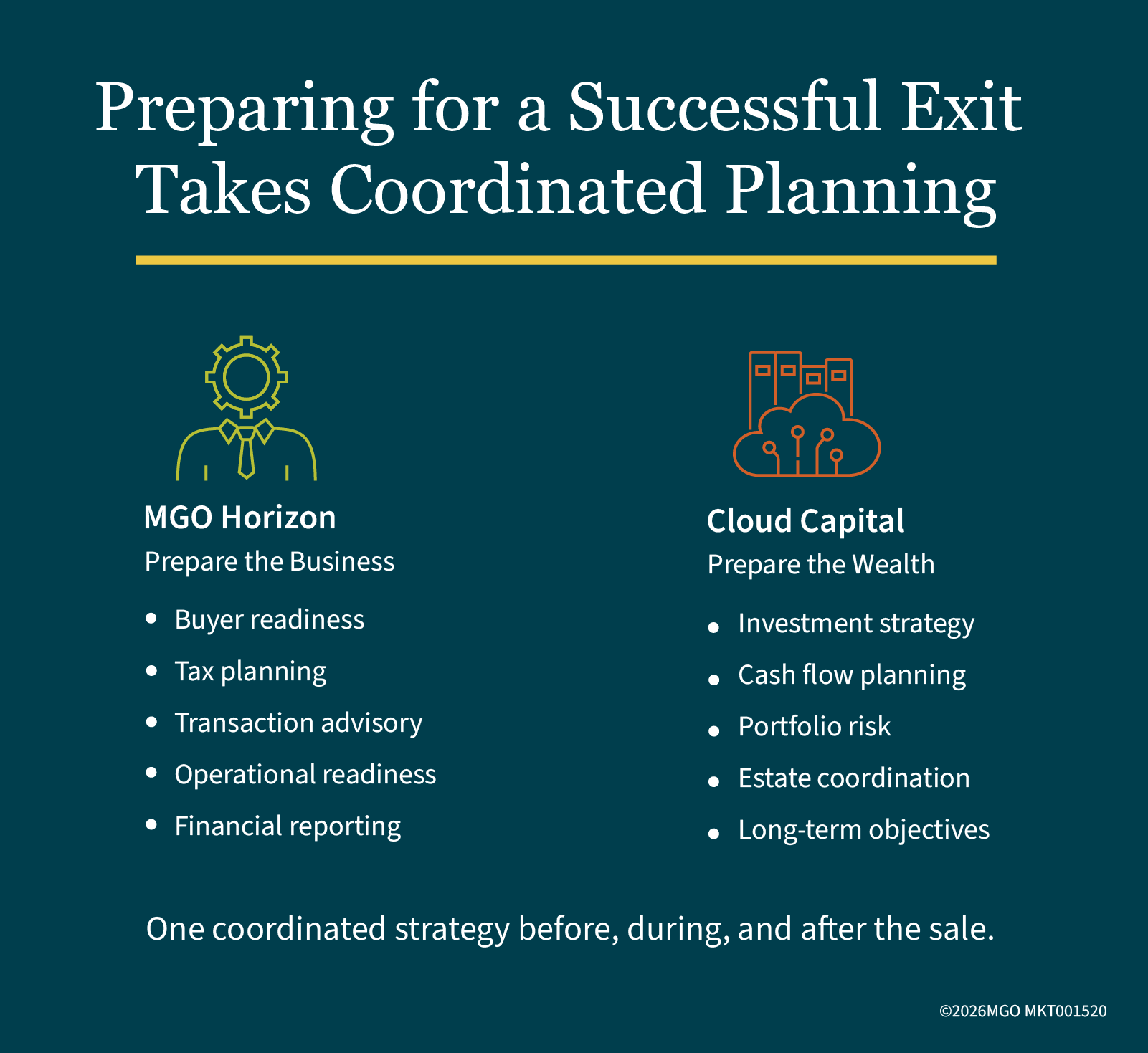
How MGO Horizon and Cloud Capital Can Help
A successful exit requires more than negotiating a favorable transaction. It requires aligning your business, your tax strategy, your personal wealth, and your long-term goals.
Through MGO Horizon, MGO works with closely held business owners years before a transaction to improve buyer readiness, strengthen financial reporting and operational processes, evaluate tax and transaction strategies, and develop a structured roadmap for ownership transition. Rather than waiting until a sale is imminent, Horizon helps you prepare your business — and yourself — to navigate the opportunities and decisions that accompany an exit.
As your business transitions into personal wealth, Cloud Capital Management helps you plan for what comes next. Their liability-driven investment approach aligns investment decisions with future cash flow needs, lifestyle objectives, and long-term financial priorities. Cloud Capital also works with business owners to define sustainable income needs, evaluate portfolio risk, coordinate estate planning considerations, and build an investment strategy designed to support the next stage of their financial journey.
Together, MGO and Cloud Capital provide coordinated guidance before, during, and after a business sale — helping you position your company for a successful transition while creating a financial strategy designed to support your next chapter.
Whether you’re planning to sell in two years or ten, the earlier you begin coordinating your business, tax, and personal wealth strategies, the more options you’ll have when the right opportunity arises. Contact us today to learn how MGO Horizon and Cloud Capital can help you prepare your business, preserve the value you’ve created, and build a confident path toward your next chapter.