
Key Takeaways:
- Internal audit delivers greater value when finance leaders and executive teams engage with auditors throughout the audit lifecycle — from risk assessment and planning through remediation.
- Collaboration can strengthen communication, improve audit efficiency, and help organizations turn audit findings into meaningful operational improvements without compromising internal audit’s independence.
- A strong relationship among internal audit, finance, and leadership can help state and local government organizations strengthen governance, manage emerging risks, and improve accountability.
—
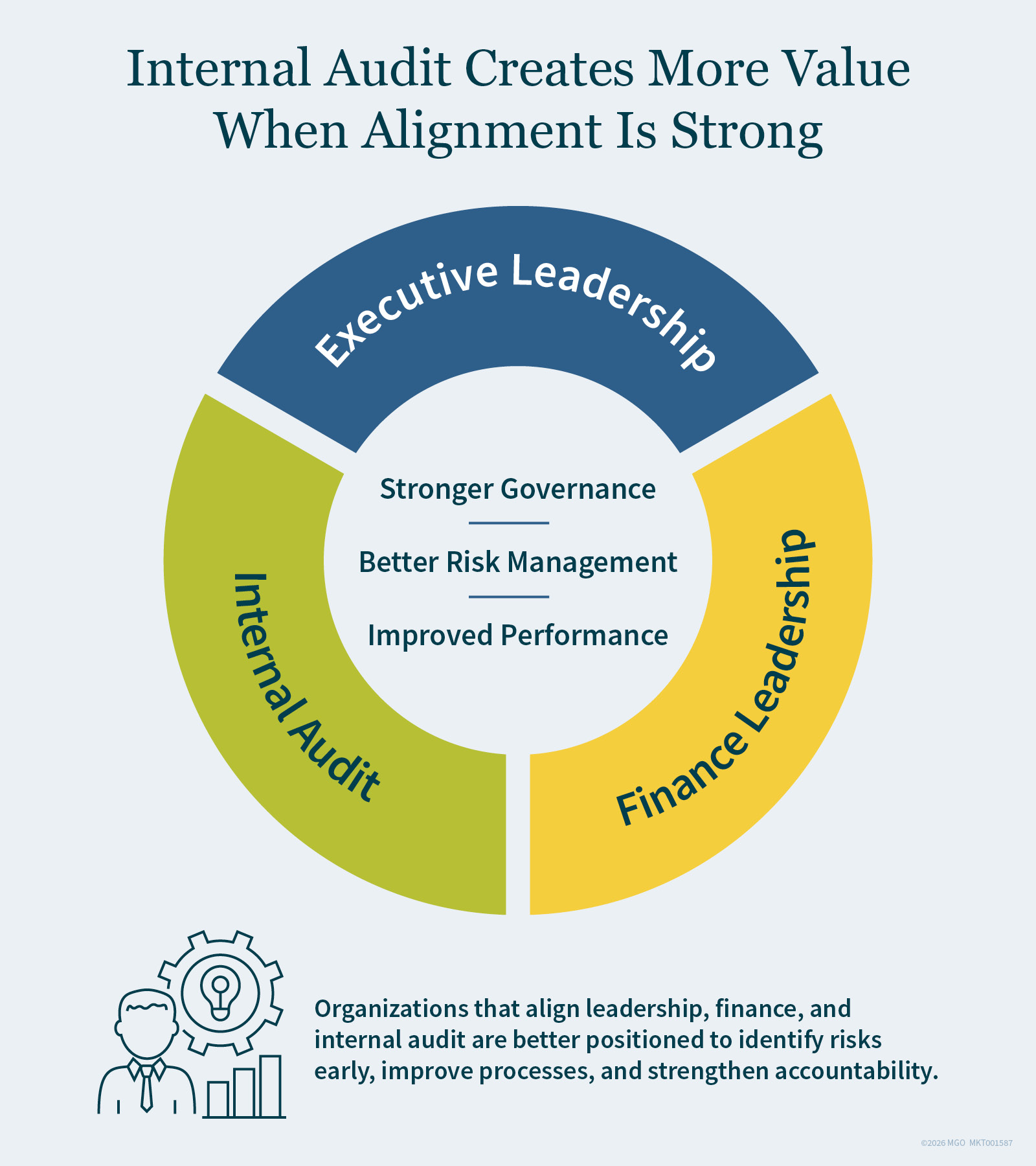
Internal audit plays a critical role in helping state and local government (SLG) organizations identify risks, strengthen controls, improve processes, and support accountability. But the value internal audit delivers depends on more than audit methodology or technical knowledge. It also depends on how effectively internal audit works with executive leadership, finance teams, and operational departments.
The goal is not to make internal audit part of management. Internal audit must maintain the independence and objectivity necessary to evaluate operations and communicate findings candidly. Instead, organizations can create greater value by giving internal auditors the context, access, and engagement they need to understand the organization and focus their work on its most important risks.
For SLG organizations facing increasing operational complexity, workforce challenges, cybersecurity concerns, evolving regulatory requirements, and heightened public scrutiny, that collaborative approach can broaden internal audit’s impact beyond compliance. It can make internal audit a valuable source of insight for managing risk and improving performance.
Internal Audit’s Strategic Role
Historically, many organizations viewed internal audit primarily as a compliance-focused activity — or even worse — a “policing” function. Compliance remains a core responsibility, but effective internal audit functions can also help leadership understand risks, evaluate controls, identify operational challenges, and make informed decisions.
Internal auditors bring an enterprise-wide perspective that can reveal trends and risks that may not be visible within individual departments. For finance leaders, this perspective can provide valuable insight into financial controls, grant compliance, procurement, technology governance, fraud risk, and operational efficiency.
That broader perspective is most useful when internal audit understands the organization’s priorities and challenges. This is why collaboration should begin before audit fieldwork.
4 Ways to Get More Value From Internal Audit
Getting more value from internal audit is not about making audits easier or reducing the level of scrutiny. It’s about creating the conditions for internal audit to focus on the organization’s most important risks, conduct its work efficiently, and help management turn insights into meaningful improvements.
1. Actively Participate in Risk Assessment: Align Audit Work With Organizational Risk
One of the most important opportunities for collaboration occurs during the risk assessment and audit planning process.
A high-impact internal audit function develops its audit plan based on an assessment of the organization’s most significant risks. Input from executive leadership, finance personnel, department managers, audit committees, and governing bodies can help auditors understand where those risks are emerging and where additional scrutiny may be warranted.
Finance leaders can provide valuable insight into:
- Emerging financial risks
- Regulatory and compliance concerns
- Operational challenges
- Technology initiatives and cybersecurity risks
- Staffing constraints
- Significant organizational changes
- New programs, funding sources, or grants
- Contract compliance issues
This information helps internal audit direct its resources toward areas that matter most to the organization rather than simply repeating the same audit procedures year after year.
For example, a new technology implementation, significant staffing change, new grant program, or change in regulatory requirements may introduce risks that were not present during the previous audit cycle. Early communication allows internal audit to consider those developments when establishing its priorities.
The result is a more risk-based audit plan that can provide leadership with meaningful insight while supporting the organization’s strategic objectives.
2. Support Audit Execution: Facilitate an Efficient Process
Once an audit activity begins, effective collaboration can improve both the audit process and the quality of its results.
Management and finance teams can support efficient audit execution by maintaining organized records, documenting key processes, establishing clear accountability for information requests, and identifying knowledgeable points of contact.
Designating a primary contact can be particularly helpful. That person can coordinate requests, answer questions, and facilitate communication between auditors and operational leaders. This reduces unnecessary back-and-forth and helps auditors obtain the information and context they need.
Operational teams also benefit when they understand what internal audit is evaluating and why. Open communication can help auditors identify relevant information that may not be apparent from documentation alone and can give management an opportunity to explain changes or unusual circumstances.
The objective, however, is not to influence the outcome of the audit. Internal audit should remain free to evaluate operations objectively and communicate findings honestly.
Instead, collaboration should give auditors a clearer understanding of the organization’s operations while helping management participate constructively in the process.
Collaboration Is Not the Same as Compromising Independence
Closer relationships between management and internal audit can sometimes raise concerns about independence. But effective collaboration does not require internal audit to give up its objectivity.
The distinction is important: management provides context and engagement; internal audit provides independent assessment.
Independence is supported through appropriate governance structures, clear roles and responsibilities, adherence to professional standards, objective reporting practices, and appropriate oversight.
Management should be able to have candid conversations with auditors, ask questions, provide relevant information, and discuss potential solutions. At the same time, internal auditors must remain willing to challenge existing practices and communicate concerns when warranted.
The strongest relationships are built on:
- Transparency
- Mutual respect
- Effective communication
- Clearly defined roles
- A shared commitment to organizational improvement
When those elements are present, collaboration can strengthen the audit process without diminishing the credibility of its results.
3. Address Findings: Turn Insights Into Meaningful Action
The value of an internal audit is ultimately determined by what happens after findings are reported.
An audit report can identify a control weakness or operational inefficiency, but the report itself does not solve the underlying problem. Organizations realize greater value when management engages with findings to understand root causes, evaluate recommendations, and develop practical remediation plans.
Finance leaders can play an important role in this process by helping:
- Prioritize corrective actions
- Evaluate resource requirements
- Assign accountability
- Establish implementation timelines
- Monitor progress
Management should also consider whether an individual finding points to a broader issue. A control deficiency in one department, for example, may reveal an opportunity to improve a process across the organization.
Formal processes for tracking recommendations can help maintain accountability and provide leadership with visibility into remediation efforts. Tracking should focus not only on whether an action was completed, but also on whether the action addressed the underlying risk and produced the intended improvement.
This shifts internal audit from a “find and fix” exercise toward a process of sustained risk management and operational improvement.
4. Build on the Results: Create a Culture of Continuous Improvement
When organizations consistently engage with internal audit before, during, and after an audit, the benefits can extend beyond individual engagements.
Over time, organizations can develop stronger risk awareness, more effective internal controls, and greater operational discipline. Employees may become more comfortable identifying potential issues, leadership can gain greater visibility into emerging risks, and departments can use recurring audit insights to improve processes.
This is particularly important for SLG organizations, where effective risk management and internal controls support more than operational performance. They also contribute to public accountability and responsible stewardship of taxpayer resources.
Internal audit should therefore not be viewed as an isolated function that evaluates completed activities. Its greatest value comes when its work is connected to the organization’s broader approach to achieving strategic objectives, managing risk, and delivering services effectively.
The relationship can be thought of as an ongoing cycle:
Plan → Audit → Correct → Continuously Improve
At each stage, management and finance teams contribute organizational context, engagement, and accountability, while internal audit provides independent assessment and insight.
That balance allows organizations to gain more value from internal audit without compromising the independence that makes the function effective.
How MGO Can Help
We provide comprehensive internal audit and consulting services for state and local government organizations looking to strengthen governance, improve operational performance, and manage risk.
Our professionals work alongside finance leaders, executive teams, audit committees, and governing boards to:
- Develop risk-based internal audit plans
- Conduct operational and compliance audits
- Assess internal controls
- Evaluate governance frameworks
- Support fraud risk management initiatives
- Improve business processes and operational efficiency
- Strengthen grant compliance and financial oversight
- Enhance organizational accountability and transparency
By combining deep public sector experience with a practical, collaborative approach, MGO helps organizations get more value from internal audit while preserving the independence, objectivity, and accountability essential to effective oversight.
Contact us today to learn how our internal audit and consulting services can help strengthen your organization’s governance, risk management, and operational performance.