
Key Takeaways:
- Fund administration plays a strategic role throughout your fund’s lifecycle, helping support growth, investor confidence, compliance, and long-term operational resilience.
- Building strong administrative processes early can reduce operational friction, improve reporting, and better prepare your fund for audits, transactions, and liquidity events.
- Taking a lifecycle approach to fund administration helps you navigate launch, active management, exit, and wind-down with greater efficiency and confidence.
—
Fund administration is often discussed in operational terms: capital calls, investor statements, tax reporting, audit support, and financial records. While these functions are essential, they represent only part of the picture.
For fund managers, administration is increasingly connected to broader questions of strategy, governance, investor confidence, and long-term readiness. The way a fund is structured, documented, reported on, and eventually wound down can influence its ability to scale, respond to market changes, complete transactions, and maintain credibility with stakeholders.
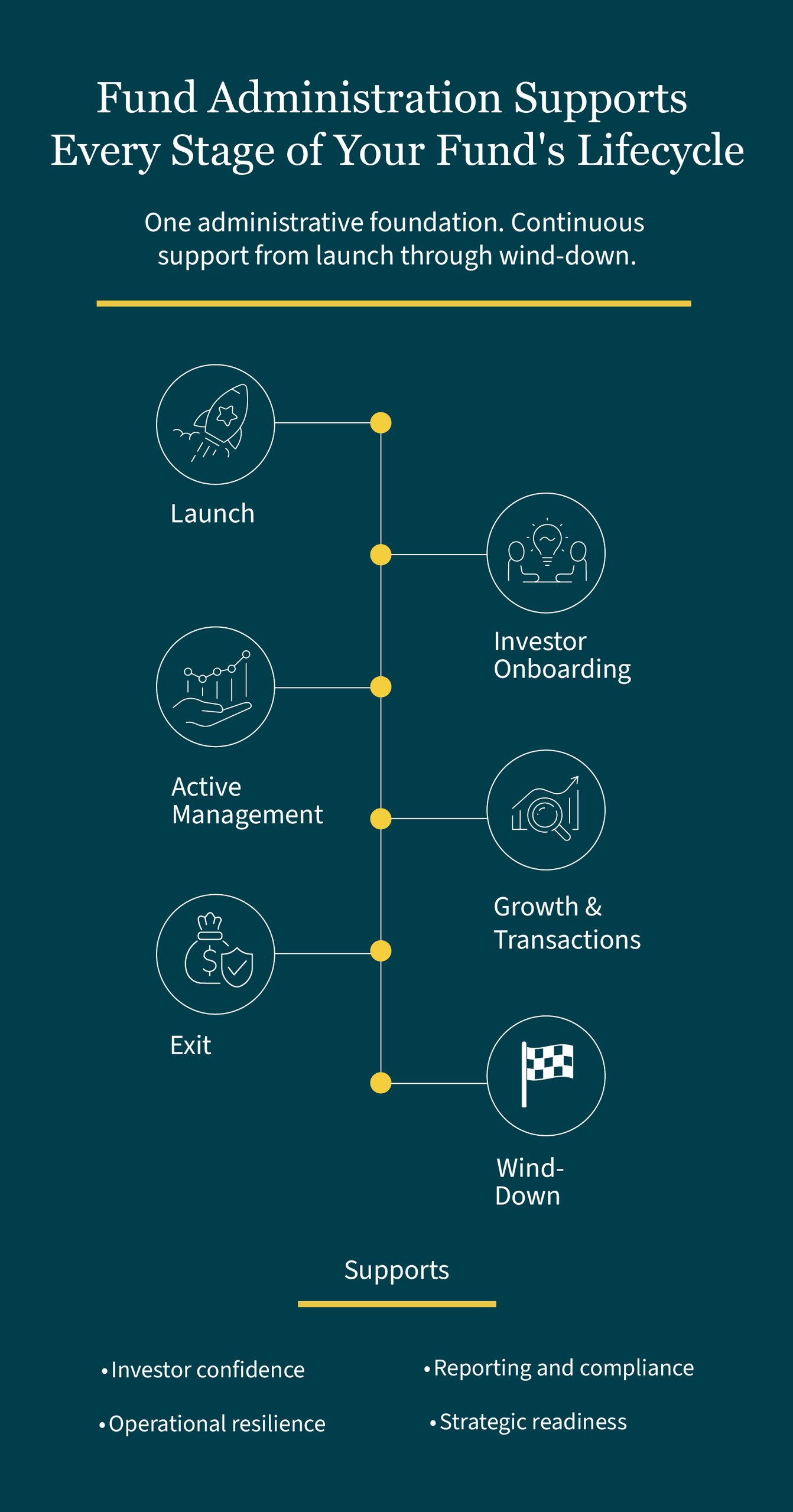
A fund’s lifecycle is not static. Each phase introduces new decisions, risks, and operational demands. From launch to exit, effective fund administration requires continuity — not simply completing discrete tasks but creating an infrastructure that evolves with the fund.
The Launch Phase: Decisions That Shape the Fund’s Future
The early stages of a fund often move quickly. You’re focused on fundraising, investment strategy, legal formation, and investor commitments. In that environment, administrative design can sometimes be viewed as a secondary concern.
But launch-stage decisions can have long-term consequences. Entity structure, tax considerations, investor reporting requirements, accounting policies, valuation frameworks, compliance workflows, and technology platforms all shape how efficiently the fund can operate later.
A fund that begins with unclear processes may face friction as activity increases. Investor data may become fragmented. Reporting may require manual workarounds. Audit preparation may become more difficult than necessary. Tax reporting may require significant cleanup. These issues are rarely the result of one major mistake; more often, they emerge from small decisions made under time pressure.
A lifecycle approach encourages fund managers to think beyond formation. It asks: What will this fund need six months from now? Three years from now? At exit? At wind-down?
That perspective can help you build an operating foundation that supports growth rather than merely enabling launch.
Investor Onboarding: Where Experience and Infrastructure Meet
Investor onboarding is one of the first points where administrative discipline becomes visible to outside stakeholders. Subscription documents, capital commitments, compliance checks, investor classifications, tax forms, and account setup all need to be handled accurately and consistently.
For investors, this process can influence early perceptions of the fund’s professionalism. For managers, it establishes the data and documentation that will support future capital calls, allocations, distributions, financial statements, tax reporting, and investor communications.
Strong onboarding is not just about collecting documents. It is about creating a reliable source of truth.
When investor information is complete, organized, and accessible, the fund is better positioned to manage downstream reporting and compliance obligations. When records are incomplete or inconsistently maintained, administrative complexity compounds over time.
This is especially important as funds raise capital across multiple closes or work with a broader range of investors. What may be manageable with a small investor base can become burdensome as the fund grows.
Active Management: The Operating Model Is Tested
Once a fund is actively investing, administrative demands become more frequent and more complex. Capital activity, portfolio transactions, management fees, carried interest, expense allocations, valuations, financial reporting, tax compliance, and investor inquiries all require coordination.
This is the phase where the fund’s operating model is tested.
A well-designed administrative framework can help you maintain timely reporting, support audit readiness, and respond to investor needs with confidence. A weaker framework may lead to delays, inconsistent data, version-control issues, or an overreliance on manual processes.
Several areas tend to become especially important during active fund management:
- Accounting and reporting: Maintaining accurate books and producing timely, consistent fund-level reporting.
- Tax compliance and planning: Addressing federal, state, local, and potentially international tax considerations, including investor-level reporting.
- Valuation processes: Supporting consistent and well-documented valuation approaches, particularly for illiquid or complex assets.
- Audit readiness: Maintaining reconciliations, schedules, and documentation throughout the year rather than preparing reactively.
- Data and technology: Using systems and analytics to improve visibility, reduce manual effort, and support decision-making.
- Regulatory compliance: Monitoring obligations as fund activities, investor expectations, and rules evolve.
The goal is not administrative perfection. It’s resilience. Your processes need to accommodate complexity without becoming overly dependent on ad hoc fixes or institutional memory.
Growth, Transactions, and Strategic Inflection Points
Funds often encounter moments when administration becomes strategically important. A portfolio company may pursue an acquisition. A refinancing may require updated reporting. A potential exit may trigger diligence requests. A new regulatory requirement may require additional documentation. Investors may ask for more detailed performance, or portfolio-level information.
In these moments, the quality of your records and processes can affect speed, confidence, and execution.
Clean data and organized documentation can make diligence more efficient. Consistent valuation processes can support defensible decision-making. Audit-ready financial records can reduce disruption. Clear investor reporting can help manage expectations during periods of change.
This is where fund administration becomes more than a back-office function. It becomes part of the fund’s strategic infrastructure.
That infrastructure is especially important in an environment where fund managers are navigating evolving market conditions, longer hold periods, fewer straightforward exit opportunities, technology disruption, and rising expectations for transparency. The ability to produce reliable information quickly can help you evaluate options and communicate clearly with stakeholders.
Preparing for Exit: Readiness Starts Before the Transaction
Exit readiness is often treated as a final-stage activity, but it is shaped much earlier in your fund’s lifecycle.
By the time a liquidity event is on the horizon, stakeholders may need financial statements, tax analyses, capital account details, valuation support, legal documentation, investor communications, and historical records. If these materials are incomplete or inconsistent, the exit process can become more difficult than expected.
Preparing for exit does not mean predicting every future transaction. It means maintaining the kind of administrative discipline that allows you to respond when opportunities arise.
Important considerations may include:
- Are capital accounts accurate and current?
- Are allocations and distributions well documented?
- Are tax positions understood and supportable?
- Are valuation conclusions consistently documented?
- Are financial records prepared for audit or diligence requests?
- Are investor agreements and side letters organized and accessible?
- Are reporting obligations clear before and after the transaction?
The more these questions are addressed throughout the fund’s life, the less disruptive they become at exit.
Wind-Down: The Final Phase Still Requires Focus
The wind-down phase can be deceptively complex. Investment activity may be ending, but administrative obligations often remain.
Final distributions, tax reporting, audits, regulatory filings, entity dissolutions, liability reviews, record retention, and investor communications all require careful coordination. Errors or delays at this stage can create frustration for investors and lingering obligations for managers.
A disciplined closeout process helps preserve the integrity of the fund’s operations. It also reinforces trust. Investors remember not only performance but also how clearly and efficiently the fund communicated throughout its life — including at the end.
Wind-down is not simply the conclusion of the fund. It is the final test of the operating model that supported it.
A Lifecycle Mindset Creates Continuity
The full fund lifecycle requires more than completing administrative tasks as they arise. It requires continuity across formation, onboarding, active management, transaction readiness, exit, and wind-down.
That continuity can help you:
- Reduce operational friction
- Improve reporting consistency
- Strengthen audit and tax readiness
- Support regulatory compliance
- Create better investor experiences
- Prepare for strategic opportunities
- Manage closeout responsibilities with greater confidence
In a market defined by change, fund managers benefit from administrative infrastructure that is adaptable, well documented, and connected to the broader goals of the fund.
How MGO Can Help
For organizations managing these demands, outside perspective can be valuable — particularly when tax, audit, valuation, technology, ESG, transaction advisory, and compliance considerations intersect.
MGO’s Financial Services practice works with asset managers, private equity and venture capital firms, and other financial services organizations to help align these disciplines across the fund lifecycle, supporting more informed decisions from launch through exit.
Wherever your fund is in its lifecycle, our team can help you evaluate and strengthen the administrative, reporting, and compliance processes that support it. Reach out to our Financial Services practice today to talk through your fund’s needs.
This article is provided for general informational purposes only and does not constitute investment, legal, tax, or fund management advice. It should not be relied upon as a substitute for consultation with qualified professional advisors familiar with your fund’s specific facts and circumstances.