
Key Takeaways:
- As your business acquires, constructs, or expands facilities, real estate ownership can create tax planning opportunities that may otherwise be overlooked.
- A cost segregation study may help identify building components that qualify for shorter depreciation periods, potentially accelerating deductions and improving near-term cash flow.
- Reviewing owned real estate after a purchase, construction project, renovation, or expansion can help you identify potential tax benefits and better understand the tax treatment of a significant business asset.
—
A manufacturer acquires a larger production facility. A distributor purchases a warehouse. A healthcare organization opens a new medical office. A dealership invests in a larger location to support growth.
In each case, the organization is making a decision to support its core business. The primary objective is not real estate investment — it’s operational capacity, geographic expansion, or long-term business growth.
Yet ownership of a facility introduces a second consideration that is often overlooked: your business has also become a real estate owner.
While your primary focus may remain manufacturing, healthcare, distribution, construction, or retail, the property itself can create tax planning strategies that are commonly associated with real estate investors. Understanding these strategies can help business owners make more informed decisions about one of the largest assets on their balance sheet.
Growth Often Leads to Real Estate Ownership
Many businesses reach a point where acquiring or developing a facility makes strategic sense. If your business is growing, the decision may be driven by several factors:
- Additional space requirements
- Long-term occupancy needs
- Supply chain considerations
- Workforce expansion
- Greater control over the operating environment
- Location strategy
Once the transaction is complete, organizations appropriately turn their attention toward construction, operations, hiring, production, and customer service. However, the building itself remains a significant capital investment. How that asset is evaluated and treated for tax purposes can have meaningful cash flow implications over time.
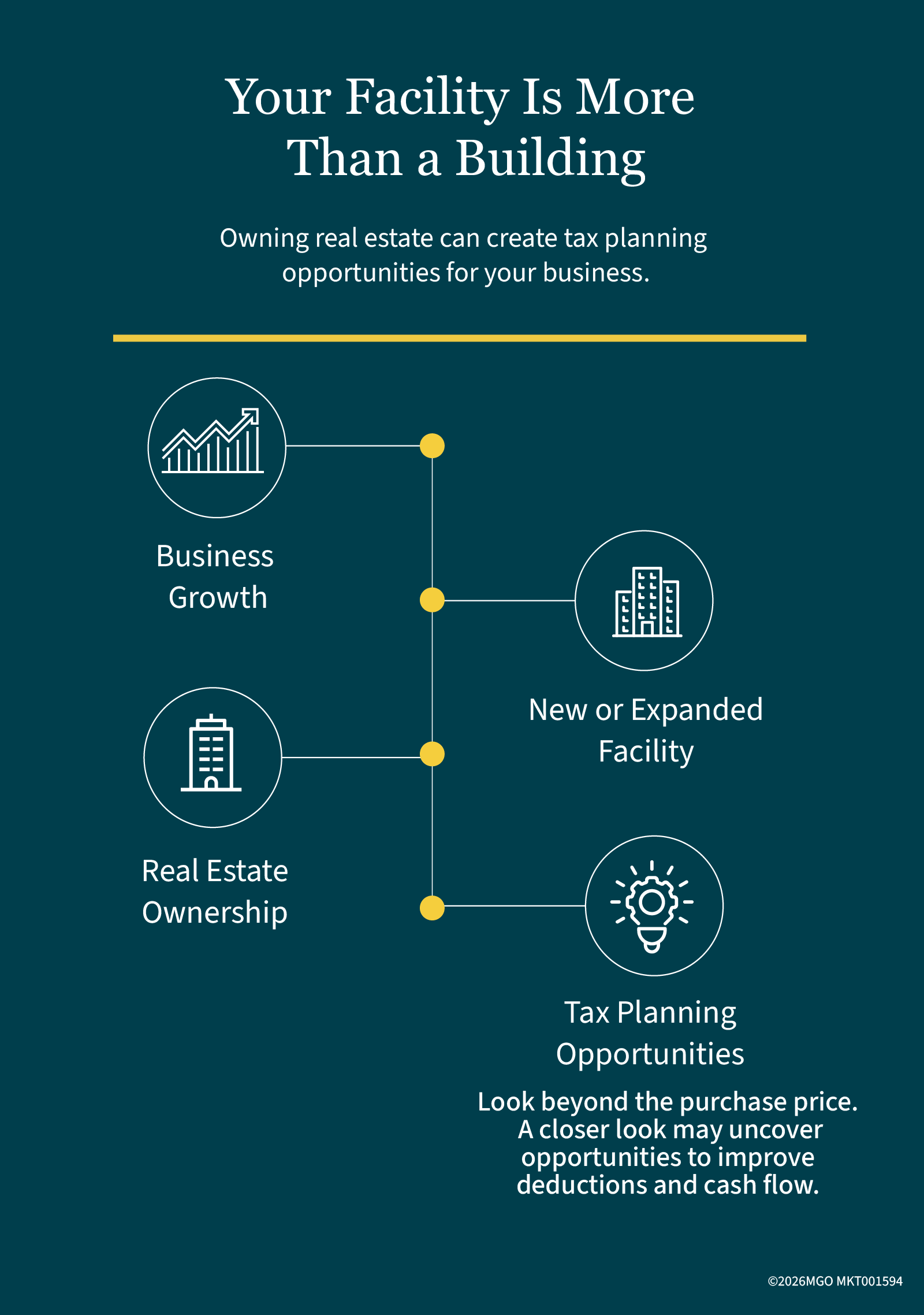
Looking Beyond the Purchase Price
When evaluating a facility acquisition or construction project, business owners often focus on the purchase price, project budget, financing structure, and expected operational benefits. Those considerations are important, but they are not the only factors that influence the financial return on a property.
Real estate investors frequently evaluate questions such as:
- How are the assets within the property classified?
- Are there ways to accelerate depreciation?
- Were renovations properly documented?
- How will future improvements be treated?
- Are there tax incentives associated with the property?
If your business occupies its own facilities, you may benefit from asking similar questions. The answers can affect tax deductions, cash flow timing, and future planning decisions.
Owner-Occupied Facilities Can Present Unique Opportunities
A commercial property is often viewed as a single asset. In reality, your facility may contain numerous components with different characteristics and useful lives.
Examples can include:
- Certain land improvements
- Interior finishes
- Specialized electrical systems
- Dedicated plumbing systems
- Site improvements
- Other building components
Understanding how these assets are categorized can help your business evaluate whether the current depreciation treatment aligns with applicable tax rules. For organizations that have recently acquired, constructed, renovated, or expanded a facility, a closer review can sometimes identify tax benefits that were not considered during the original project.
Cost Segregation: A Strategy Often Associated With Investors
Cost segregation is frequently discussed in the context of commercial real estate investors. But it may also be relevant for operating businesses that own their facilities.
A cost segregation study analyzes a property to identify assets that may qualify for shorter depreciation recovery periods than the building itself. By separating qualifying components from the overall building structure, businesses may be able to accelerate depreciation deductions.
For some organizations, this can improve near-term cash flow by shifting more tax deductions into earlier years of ownership. The potential benefit often depends on factors such as:
- Property type
- Construction cost
- Acquisition cost
- Renovation scope
- Ownership structure
- Tax profile
Because every situation is different, whether a cost segregation study could benefit your business is generally best evaluated through a property-specific analysis.
Common Situations Worth Reviewing
Business owners may want to consider a review when they have recently:
- Purchased a commercial building
- Constructed a new facility
- Completed a significant renovation
- Expanded an existing location
- Acquired a company that owns real estate
- Made substantial tenant improvements before occupying a property
In many cases, the conversation begins with a straightforward question: Have we evaluated whether our facility presents any real estate-related tax planning opportunities?
For some organizations, the answer may confirm that current treatment is appropriate. For others, it may uncover tax benefits that were not initially identified.
A Different Way to Think About Business Growth
Most business owners do not describe themselves as real estate investors. They identify as manufacturers, contractors, healthcare providers, distributors, retailers, or service providers.
Yet when your company owns the property from which it operates, real estate becomes part of the business equation. That doesn’t mean the organization is in the real estate business. It means that real estate-related planning strategies may deserve a place in the broader conversation around growth, investment, and cash flow management.
As your facilities grow and capital investments increase, evaluating the tax treatment of those assets can be an important part of getting more value from that investment.
How MGO Can Help
MGO works with privately held businesses, high-net-worth individuals, and organizations across a variety of industries to evaluate tax planning strategies related to owned real estate. For businesses that have acquired, constructed, expanded, or renovated facilities, we can assess whether a cost segregation study may be beneficial and identify other real estate-related tax considerations that align with the organization’s broader financial objectives.
In addition to cost segregation services, MGO provides tax planning, tax compliance, transaction advisory, construction cost consulting, and other services that can support businesses throughout the lifecycle of a real estate investment.
Reach out to our team today to discuss whether your owned facilities may present opportunities to improve cash flow, accelerate tax benefits, and support your broader business objectives.