
Key Takeaways:
- AI productivity gains should account for review, rework, and other workflow costs to establish how much net capacity an AI use case releases.
- Demonstrating AI’s business value requires measurable outcomes, documented costs, and evidence connecting results to the investment.
- Effective AI governance requires assessing risks, validating controls, and confirming that available evidence supports the proposed scope of use.
—
A finance team reports that its AI pilot saved 100 hours last month. The sponsor wants to expand. The CFO wants to know where the savings went. The risk leader wants to know whether the results have been validated. All three are asking about the same workflow, but they may be looking at different evidence.
The next decision should bring those views together. Before expanding an AI use case, leaders need to understand what improved, what it costs to achieve that improvement, and whether the controls support the proposed scope of use.
The Pressure to Show Value Is Real
In a 2026 Gartner survey, 75% of functional leaders identified productivity as a target outcome for AI. Yet only 22% of organizations had scaled AI across multiple business units or adopted an AI-first approach. The survey covered 1,303 respondents at organizations with at least $50 million in annual revenue. These findings describe the surveyed population; they do not establish what any individual pilot will deliver.
For your organization, the question isn’t simply whether AI can save time. It’s whether the results justify the investment and support the next step. Start with one targeted business workflow and the decision you need to make about it.
Follow the 100 Hours
Consider a hypothetical accounts-payable team processing 1,000 comparable invoices each month. Initial screening previously required 160 staff hours. An embedded machine-learning model flags potential invoice exceptions and reduces core screening effort to 60 hours. Employees still post invoices and authorize payments; the AI has no authority to do either.
At first glance, that’s a 100-hour saving. But the team adds 30 hours of review and 10 hours of correction. Other workflow efforts are unchanged. After accounting for that additional work, the net capacity released is 60 hours.
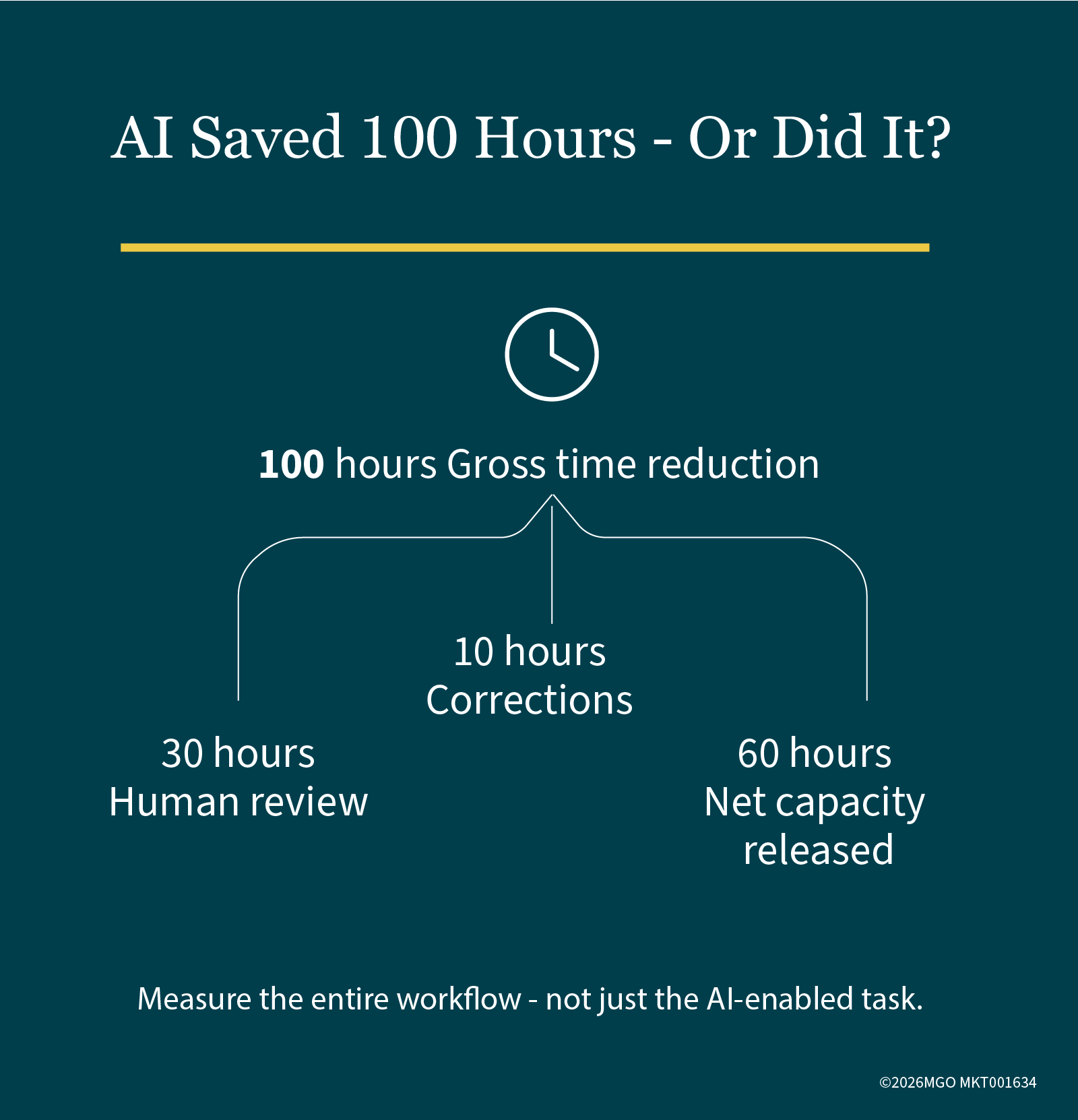
What happens to those 60 hours matters, too. The team uses 40 for documented vendor follow-up, while 20 remain unallocated. Payroll and overtime spending have not changed. The backlog falls from 500 items to 350, but other process changes prevent the team from attributing the entire improvement to AI.
The supportable statement is specific: the pilot released 60 net staff hours in the measured period of which 40 were used for documented activities. It has not yet demonstrated cash savings or established how much of the backlog reduction can be attributed to AI.
Decide Which Value You Want to Create
Released capacity can be valuable. It can help your team resolve exceptions faster, absorb growth, improve service, or spend more time on work that requires human judgment. The key is to define the outcome you want and how you’ll know whether you’ve achieved it.
A labor-rate calculation can estimate the value of time, but it doesn’t establish that cash left the budget. Different benefit claims call for different evidence.
| Benefit claim | Evidence that would support it |
| Capacity used | Comparable effort records, named work, accountable owner, and evidence showing how released time was used. |
| Better service or quality | A defined outcome, such as turnaround, repeat contacts, or missed exceptions, with a baseline and attribution limits. |
| Lower cash spending or avoided cost | A documented spending reduction or credible avoided commitment, with supporting timing, assumptions, and finance review. |
Higher costs can still be an acceptable trade-off for better quality or service. You don’t need to force every useful AI application into a savings narrative. What matters is being clear about the benefit you’re pursuing and having the evidence to support it.
Identify Your AI Type and Its Oversight
AI includes more than chatbots. Machine learning (ML) learns patterns from data and supports uses such as forecasting, scoring, and detection. Generative AI also uses ML. The categories below describe practical uses and can overlap; they are not separate branches of a technical taxonomy. Include AI features embedded in software your organization already uses.
| AI use category | Examples and assessment focus |
| Predictive and analytical ML | Forecasting, fraud detection, and scoring. Assess data quality, validation, false positives and missed cases, bias where relevant, and performance drift. |
| Generative AI | Drafting text, code, or images. Assess unsupported content, source reliability, sensitive data, prompt injection, and meaningful review. |
| Agentic AI | Systems that plan and take action through tools. Assess permissions, approvals, action and spending limits, monitoring, and containment. |
| Physical AI | Robots and systems operating in the physical world. Assess safe operating limits, environmental conditions, interlocks, and specialist review. |
Knowing what type of AI you’re using is only part of the picture. You also need to know whether its use is approved and operating within established boundaries.
Shadow AI is an oversight status and is AI used without required approval or outside approved boundaries. It can involve an ML model, a GenAI tool, an agent, or an embedded feature. Record approval separately from AI type; an approved application does not approve every use of its AI features.
You should also document the adoption stage — experiment, pilot, production, or expansion — reach, and authority: recommend, act after approval, or execute within limits. For example, a forecasting model used in production without verified approval presents a different review need from an approved GenAI pilot limited to public information.
These distinctions help you determine what needs attention, who needs to be involved, and what level of oversight makes sense.
Start With a Business Case, Readiness, and Impact
Before you invest in or expand an AI use case, define the business problem, establish a baseline, and identify the outcome you want to achieve. Consider alternatives, too. Better procedures or conventional automation may solve the problem without introducing additional AI-related risks.
Next, assess whether your organization is ready. Consider data quality, integration, reviewer capacity, ownership, skills, vendor visibility, and budget. Then assess the potential impact: which areas could be affected, how errors or misuse could cause harm, and what safeguards you’ll need.
For generative AI, account for risks specific to generated content and how people or systems will use it. The National Institute of Standards and Technology (NIST) Generative AI Profile provides a useful reference. The assessment still needs to reflect the actual workflow; a tool branded “GenAI” doesn’t describe every risk in a connected system.
A bounded pilot should test a specific hypothesis under defined limits for data, users, authority, cost, and time. Once the system is in use, replace assumptions with observed evidence before expanding those limits. Revisit the assessment whenever the purpose, provider, model, data, permissions, or scale changes.
Test the Workflow, Not Just the Model
In the invoice example, faster screening doesn’t show whether the AI is missing invoices that need additional review. And a policy stating that the AI can’t post or pay invoices doesn’t prove those restrictions work as intended.
You need evidence that the workflow performs as expected and that the safeguards work in practice. Assess representative work, known exceptions, effective permissions, and the approvals required for the proposed expansion. Document the criteria, population, results, limitations, reviewer, and date.
Human review needs the same attention. Can reviewers identify consequential errors? Do they have enough time and information to do so? Can they intervene when something goes wrong? For agents, test what happens to credentials, queued work, and downstream actions when access is denied or a stop is triggered.
The stakes are growing as organizations give AI systems more authority. In May 2026, Gartner predicted that by 2027, 40% of enterprises would demote or decommission autonomous agents because of governance gaps discovered after production incidents. That is a forecast, not an observed failure rate.
The practical takeaway is straightforward: before giving an AI system more authority, understand what it can do, how you can intervene, and how you’ll recover if something goes wrong.
Close the Defensibility Gap
The defensibility gap is the distance between what management claims — or permits — and what the available evidence supports. Closing that gap means being able to explain why you’re making a decision and point to the evidence behind it.
That starts with understanding the full cost of an AI use case. Include licenses, usage, integration, review, rework, re-attempts, monitoring, and recovery. Separate one-time investment from recurring costs. Compare cost per acceptable completed result only when scope, period, and quality criteria are comparable. Keep unknowns visible; a blank cost isn’t zero.
In the invoice pilot, full costs remain incomplete, exception-handling performance hasn’t been established, and posting restrictions still need testing. The 60 hours of released capacity are useful evidence, but they aren’t enough on their own to justify giving the system more authority. Management needs to document whether the current limits are appropriate for continued use, what needs to be resolved, and who can authorize expansion.
It’s also important to distinguish between control evidence and value evidence. Strong safeguards don’t prove return on investment, and favorable results don’t justify unresolved critical exposure. Where the workflow affects financial reporting, assess the specific reporting risks and relevant controls — AI use alone doesn’t determine ICFR scope.
In other words, you need both sides of the story: evidence that the AI delivers the intended business value and evidence that the risks are being managed appropriately.
When the Starting Point Is Shadow AI
Sometimes the first step isn’t evaluating a new AI opportunity. It’s finding out how an AI tool is already being used without the required approval or outside approved boundaries.
In that situation, start by identifying the data, identities, actions, and downstream reliance involved. Security, privacy, counsel, and other responsible teams can assess the exposure and notification requirements. An approval gap isn’t automatically a material incident, but uncertainty calls for prompt triage.
IBM’s 2025 breach study found average costs were $670,000 higher at breached organizations with high shadow AI use than at those with little or none. This is an association in a breach-study population, not an estimate of the loss from a particular AI usage.
Once the response path is established, a legitimate business need can move into a separate readiness and value assessment. Keep the two decisions separate: potential benefits don’t resolve an incident or stop a notification clock.
Connect AI Governance to Business Decisions
AI Control to Value is MGO’s approach to AI governance, risk, controls, and compliance services. It brings business goals and risk management into the same conversation, connecting who may authorize AI use, what could go wrong, which requirements apply, how safeguards perform, and whether the results support continued investment.
For the invoice workflow, that means identifying an accountable owner and setting authority limits; assessing missed errors and inappropriate payments; testing permissions and review; and documenting how applicable policies, contracts, and reporting requirements connect to controls and supporting evidence. The 60-hour result is one part of that picture, alongside the findings that determine whether expansion makes sense.
The same approach can extend beyond a single pilot. An enterprise AI inventory, consistent intake and approval criteria, an obligations register, and scheduled control and outcome reviews help management oversee multiple uses. Changes in models, data, permissions, providers, or requirements trigger reassessment.
A successful pilot is a starting point, not the end of the process. As your AI use grows, ongoing oversight helps you keep business results, risk, and controls aligned.
Bring One Workflow to Your Next Leadership Meeting
Ask the business process owner, finance, and the technology and risk leaders to prepare one decision record — the next decision, permitted scope, observed results and full costs, tested safeguards and unresolved gaps, and the approver, conditions, and review date. Internal audit can evaluate the evidence and controls while management retains ownership of the decision.
The accompanying AI Value Evidence Worksheet helps build that record. Enter observed results or pilot assumptions and export the gaps and decisions for discussion.
How MGO Can Help
You don’t have to figure out the right next step for every AI use case on your own. Whether you’re evaluating a pilot, considering a broader rollout, or trying to get a handle on shadow AI, MGO’s IT risk team can help you assess readiness and impact, design governance, evaluate risks and controls, map compliance requirements to supporting evidence, and plan ongoing oversight through AI Control to Value.
Contact us to discuss your AI use case, the decisions you’re facing, and the evidence you need to determine what comes next.