
Key Takeaways:
- While OMB’s proposed overhaul of the Uniform Guidance is delayed until at least December 11, 2026, the proposal provides import insight into future federal expectations for grant recipients and pass-through entities.
- Although the final rule may differ from the May 2026 proposal, organizations should evaluate areas most likely to require operational changes, including risk assessments, subrecipient monitoring internal controls, payment documentation, and grant oversight.
- Organizations that perform a proactive readiness assessment now will be better positioned to adapt quickly once a final rule is issued.
—
If your organization receives or administers federal financial assistance, you may have been preparing for significant changes to the Uniform Guidance on October 1, 2026. That timeline has changed.
On May 29, 2026, the U.S. Office of Management and Budget (OMB) proposed sweeping revisions to 2 CFR Part 200, which governs the administration, cost principles, and audit requirements for federal awards. The proposal would make significant changes to federal grant administration, including provisions affecting award oversight, subrecipient monitoring, cost allowability, payment documentation, and other compliance requirements.
However, a provision in the continuing appropriations legislation signed in September temporarily prevents OMB from finalizing the proposed rule, or a substantially similar rule, through December 11, 2026. If a covered rule were finalized before the legislation took effect, it also could not take effect during that period.
For many organizations, this creates a period of uncertainty but also an opportunity to prepare.
What Happens to Uniform Guidance Now?
The most important point is that the proposed changes are not currently the requirements your organization should be following.
For now, continue complying with the Uniform Guidance and other requirements that apply to each federal award. The applicable requirements can depend on the award date, award terms and conditions, federal agency requirements, program-specific regulations, and other applicable guidance.
The December 11 deadline also does not necessarily represent the end of the uncertainty. After that date, several outcomes are possible. OMB could finalize the proposal, issue a revised version, establish a new implementation timeline, or take another approach.
That means organizations should avoid making wholesale changes based solely on the May 29 proposal. At the same time, waiting for a final rule before evaluating potential impacts could leave little time to respond.
Potential Areas of Impact
While the final rule will likely be modified in response to stakeholder feedback, several overarching themes appear throughout the proposal and are consistent with broader federal efforts to strengthen grant oversight and accountability.
Organizations should pay particular attention to the following areas:
Enhanced Risk Assessment Expectations
The proposed rule would expand pre-award and ongoing risk assessment considerations, including greater emphasis on organizational capacity, prior performance, and other risk indicators.
Even if specific criteria change, federal agencies and pass-through entities are increasingly expected to demonstrate that risk assessments are documented, repeatable, and linked to monitoring decisions.
Increased Focus on Subrecipient Oversight
Several proposed provisions would strengthen expectations around subrecipient monitoring, documentation, and enforcement.
Organizations should anticipate continued scrutiny regarding:
- Risk assessment methodologies
- Monitoring plans
- Documentation and oversight activities
- Follow-up on identified findings
- Corrective action tracking
More Detailed Financial Documentation
The proposal would require additional support for certain payment requests and expenditure documentation.
Regardless of the final language, organizations that cannot clearly demonstrate how federal funds were used may face increased compliance risk.
Stronger Internal Control Expectations
While some proposed language would modify references to specific frameworks, the proposal reinforces expectations for documented internal controls, management oversight, and monitoring activities.
Expanded Federal Oversight Authority
The proposal would provide agencies with broader authority over award administration, enforcement, and termination decisions.
Although details may change, organizations should expect continued focus on recipient accountability and performance documentation.
Use the Waiting Period to Assess Your Exposure
A good starting point is to understand exactly how much your organization depends on federal funding and where proposed changes could create risk.
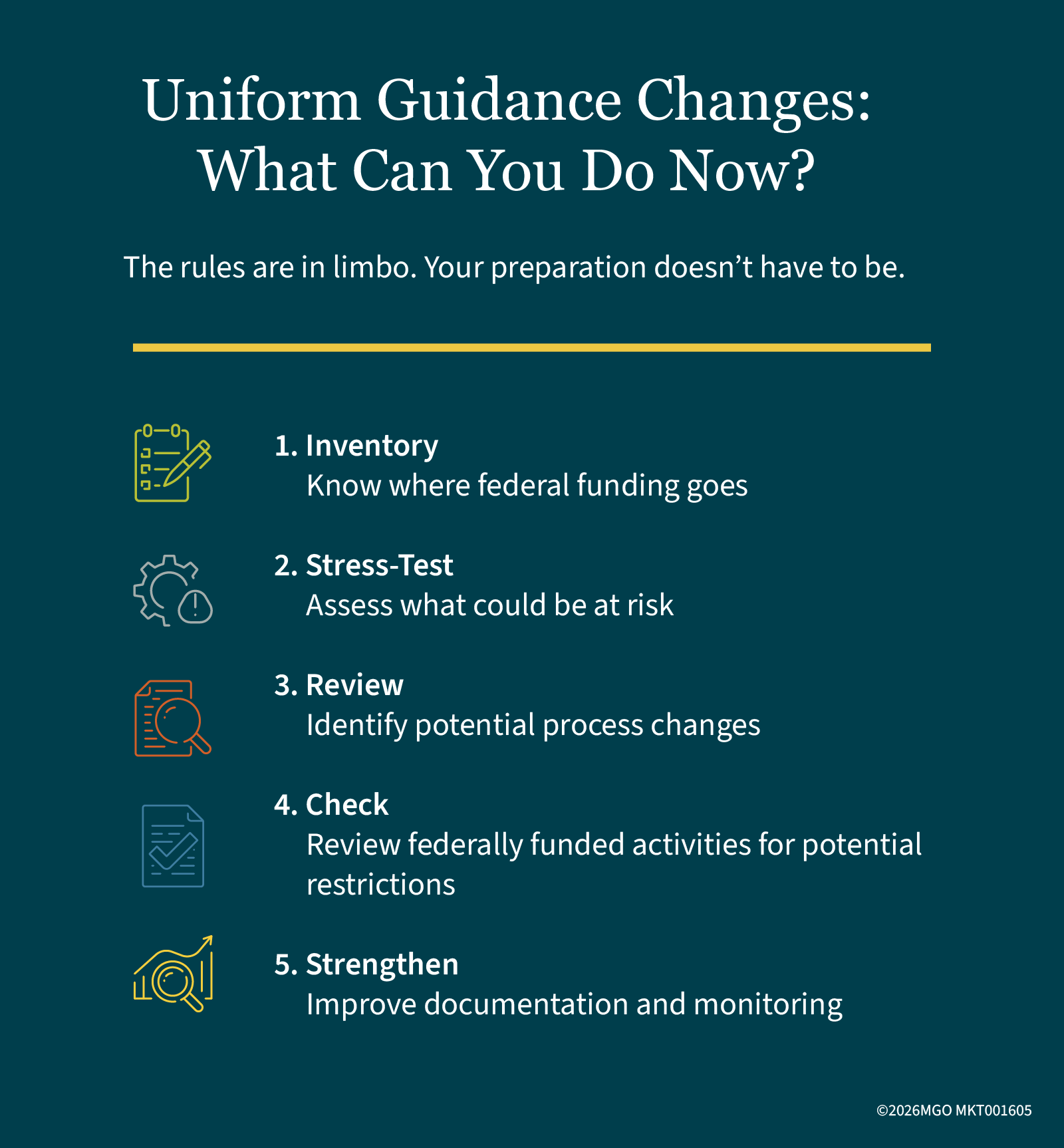
1. Inventory Your Federal Funding
Identify the federal awards currently supporting your programs, projects, and operations. Consider both direct awards and funding received through pass-through arrangements.
For each significant award, consider:
- What program or activity does the funding support?
- When does the award expire?
- Is continued or renewed funding expected?
- How much of the program depends on federal funding?
- Are there significant commitments tied to the award?
- Are subrecipients or other partners dependent on the funding?
Pay particular attention to multiyear projects. If a construction project or other major initiative relies on federal funding, consider what would happen if future funding became delayed, discretionary, restricted, or unavailable.
This exercise can help identify programs that warrant a closer look if federal funding conditions change.
2. Stress-Test Programs That Rely on Federal Funding
Once you understand where federal dollars are being used, consider what could happen under different scenarios.
For example, what would happen if a federal award were delayed or not renewed? Could the organization continue the program using other funding sources? Would contracts, staffing, construction commitments, or payments to subrecipients continue?
You may not be able to predict what OMB or individual federal agencies will do. You can, however, identify where your organization would have the greatest exposure and develop contingency plans accordingly.
3. Perform a Uniform Guidance Readiness Assessment
Rather than immediately revising policies and procedures, organizations should conduct a structured readiness assessment focused on the areas most likely to be affected if the proposal is substantially finalized.
Risk Assessments
Questions to consider:
- Is every federal program subject to a documented risk assessment?
- Are risk ratings linked to monitoring activities?
- Are risk assessments updated periodically?
- Are financial, compliance, and performance risks evaluated consistently?
Potential actions:
- Standardize risk assessment methodologies
- Document risk scoring criteria
- Establish procedures for periodic reassessment
Subrecipient Monitoring
Questions to consider:
- Is monitoring risk-based?
- Are monitoring activities consistently documented?
- Are corrective action plans tracked to completion?
- Are monitoring procedures applied consistently across programs?
Potential actions:
- Evaluate current monitoring procedures
- Strengthen monitoring documentation
- Develop standardized corrective action tracking processes
Internal Controls
Questions to consider:
- Are key grant management controls documented?
- Are responsibilities clearly assigned?
- Are management reviews documented?
- Is ongoing monitoring performed?
Potential actions:
- Update control narratives and procedures
- Formalize management review requirements
- Document monitoring activities consistently
Allowable Costs and Financial Oversight
Questions to consider:
- Are expenditures reviewed consistently for allowability?
- Is supporting documentation readily available?
- Are allocation methodologies documented?
- Can expenditures be tied quickly to a specific award?
Potential actions:
- Strengthen expenditure review processes
- Improve documentation standards
- Formalize cost allocation procedures
4. Review Federally Funded Activities for Potential Restrictions
Some proposed provisions could affect whether certain activities or expenditures are allowable under federal awards. The proposal also includes policy-based restrictions that could create uncertainty around certain federally funded programs and activities.
For example, the proposed rule includes several provisions that could expand federal scrutiny over whether grant-funded activities align with statutory requirements, program objectives, and federal policy priorities. Other proposed changes could affect the allowability of certain foreign collaborations, specific administrative activities, or expenditures that cannot be clearly connected to approved grant purposes. While the final language may change, organizations should evaluate whether they can clearly demonstrate how federally funded activities support program objectives and comply with applicable award requirements.
Organizations may need to pay closer attention to whether expenditures provide a direct benefit to the federally funded program and can be clearly supported as necessary, reasonable, and allocable to accomplishing award objectives. Several proposed revisions would place greater emphasis on documenting the connections between a cost and the specific program activities being funded. Costs that may historically have been viewed as generally supportive of an organization could receive greater scrutiny if the program benefit is not clearly documented.
Examples of cost categories organizations may want to review include:
- Conference, meeting, and event-related expenses charged to federal awards, including documentation showing how attendance or participation directly benefits the federally funded program.
- Public relations, outreach, or communications costs funded with federal grants, including support showing how the activity advances program objectives rather than general organizational promotion.
- Administrative and support costs allocated across multiple programs, including methodologies used to demonstrate allocability to the federal award.
- Consultant and contractor costs where deliverables, scope of work, and program benefit are not clearly documented.
- Training, travel, and professional development costs where the connection to program objectives may not be readily apparent.
- Shared costs that rely heavily on management judgement or cost allocation methodologies.
Organizations should be prepared to demonstrate not only that these costs were properly documented, but also why the expenditures were necessary for the performance of the award and how they directly supported the purpose, objectives, and expected outcomes of the federal program.
This makes it particularly important to distinguish between activities supported with federal funds and those supported with state, local, or other funding sources. Organizations should be able to clearly demonstrate which activities, personnel costs, contracts, and program expenditures are being charged to federal awards and why those costs are allowable under the award terms and applicable requirements.
An organization may continue an activity using state, local, or other nonfederal funding even if a future federal requirement limits the use of federal dollars for that activity. The key is knowing which funding source supports which activity and having processes to identify and address changes in allowability.
5. Strengthen Documentation and Monitoring
Good documentation is valuable regardless of what happens with the proposed rule. Organizations should review documentation and monitoring as foundational capabilities that are likely to remain important regardless of how the final rule evolves. Many of the proposed changes either directly increase documentation expectations or rely on documentation to demonstrate compliance.
Review whether your organization can readily demonstrate:
- Why a cost was charged to a federal award
- How expenditures were reviewed and approved
- How subrecipients were selected, assessed, and monitored
- How compliance requirements are communicated to program staff
- How changes in federal requirements are incorporated into operations
- How risk assessments support monitoring decisions and oversight activities
Clear documentation can help reduce compliance risk today while making future changes easier to implement.
A Practical Roadmap for the Next 60 Days
Organizations do not need to implement proposed requirements before the final rule is issued. However, they can take meaningful steps now to improve readiness.
Phase 1: Understand Exposure
- Inventory all federal awards
- Identify high-risk programs
- Evaluate significant subrecipient relationships
- Assess organization reliance on federal funding
Phase 2: Evaluate Readiness
- Perform a gap assessment
- Review grant policies and procedures
- Assess monitoring practices
- Identify documentation weaknesses
Phase 3: Develop and Implementation Strategy
- Prioritize potential policy updates
- Identify training needs
- Establish ownership of implementation activities
- Develop timelines for future updates
Phase 4: Monitor Final Rule Developments
- Track OMB announcements
- Review the final rule when issued
- Compare final requirements to the readiness assessment
- Update implementation plans, as needed
Prepare Now Without Implementing Too Soon
The current delay provides organizations with an opportunity to prepare strategically rather than reactively.
While the final Uniform Guidance rule may differ from the May 2026 proposal, the proposal itself provides valuable insight into the direction of federal grant oversight. Organizations that use this transition period to assess grant management practices, evaluate monitoring activities, strengthen documentation, and identify operational gaps will be better positioned regardless of how the final rule ultimately evolves.
The most effective approach is not to implement every proposed requirement today, but to understand where future proposed changes may affect existing processes and develop an implementation strategy before new requirements become effective.
How MGO Can Help
MGO’s State and Local Government team helps public sector organizations navigate changing federal grant requirements and assess the potential impact on their programs, funding, and compliance processes. We can help you evaluate federal funding dependencies, identify potential risk areas, review grant administration and subrecipient monitoring processes, and prepare for changes to the Uniform Guidance.
Contact MGO to discuss how your organization can use this transition period to prepare for what comes next.