
Key Takeaways:
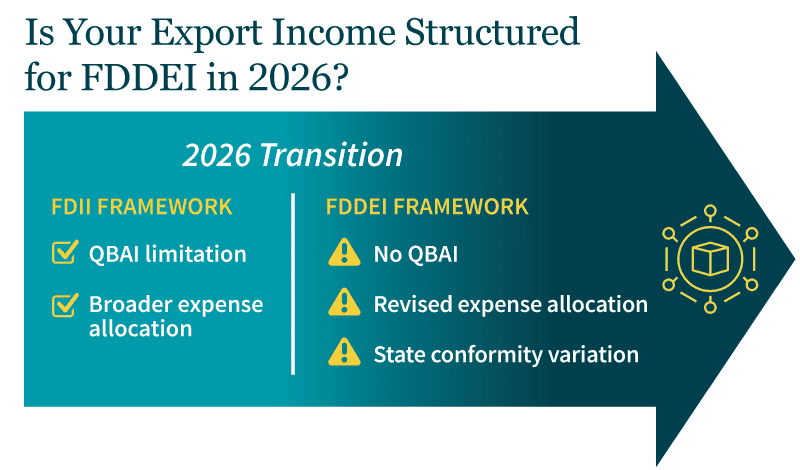
- FDDEI replaces FDII in 2026, eliminating qualified business asset investment and changing how export-related income qualifies for a federal deduction.
- Revised expense allocation rules may expand the amount of income treated as eligible for certain exporters.
- State conformity differences require coordinated international tax and state and local tax modeling.
—
If your organization generates revenue from customers located in foreign countries, 2026 may change how that income affects your tax position.
Foreign-derived deduction eligible income (FDDEI) replaces the prior foreign-derived intangible income (FDII) framework, changing how this income is calculated and deducted at the federal level. While the policy goal remains similar — encouraging U.S.-based production and services to foreign markets — the mechanics have shifted in meaningful ways.
For CFOs and tax directors, the key question is not whether the deduction still exists. It’s whether your export income is structured to benefit under the revised framework.
What Changed Under FDDEI in 2026?
Under the former FDII rules, a part of export income was reduced by a deemed routine return on qualified business asset investment (QBAI). With QBAI eliminated under the revised regime, that limitation no longer applies. By removing the “intangible” requirement, FDDEI is now a broader tax incentive for U.S. corporations exporting goods and services, particularly benefiting asset-intensive industries like manufacturing.
Generally, FDDEI includes gross income from:
- Sale of property: Sold to a non-U.S. person for foreign use.
- Services: Provided to a person or with respect to property located outside the U.S.
This change alters the baseline from which the deduction is calculated. In addition, expense allocation rules have been changed. Certain categories of interest and research expenses are no longer allocated in the same manner as under prior law.
While the Section 250 deduction percentage has been adjusted, the combined effect of removing QBAI and revising allocation of mechanics may increase the amount of income treated as eligible under FDDEI for some businesses.
The policy as originally constructed under the FDII regime was designed to boost domestic manufacturing by rewarding companies that develop and export goods from the U.S., effectively replacing older domestic production incentives. FDDEI continues to benefit this sector.
In addition to manufacturing, the regime also extends to certain service industries. For example, transportation companies moving items across borders may have a portion of their income sourced outside the U.S. if they meet the documentation requirements. Given the breadth of industries these rules touch, the impact on your business will depend on how your organization generates and reports export income. To position your company to capture available benefits, consult with our international tax practitioners.
How Does FDDEI Affect Your Export Income?
FDDEI applies to income derived from goods manufactured in the United States and sold to foreign customers, as well as certain services provided to foreign persons.
If your organization manufactures domestically and distributes internationally, the removal of QBAI may change the calculation of eligible income. Companies with significant tangible assets may see a different inclusion profile than under FDII.
Technology and life sciences businesses that provide services or license intellectual property from the United States to foreign customers may also experience a recalibration of deduction eligibility, depending on the underlying structure and expense profile — particularly where expense allocation rules previously reduced the qualifying base.
The impact is not uniform across industries. Your operational model matters.
Are Your Expense Allocation Assumptions Still Valid?
Under prior rules, interest and research expenses were distributed in a way that could reduce FDII-eligible income. The revised framework limits certain expense allocations, which may increase the deduction base for some taxpayers.
If your prior modeling assumed specific reductions for research and development or interest expense, those assumptions may no longer apply in 2026.
Because FDDEI interacts with net CFC tested income (NCTI), foreign tax credit limitations, and other international provisions, modeling one provision in isolation may not provide an exact picture.
Evaluating how revised allocation rules affect your overall income profile is an essential step in understanding the true impact.
How Do State Conformity Rules Affect Your FDDEI Benefit?
Federal treatment does not automatically dictate state and local tax (SALT) treatment.
Some states conform to federal deduction mechanics in real time. Others adopt the Internal Revenue Code as of a fixed date. Certain state jurisdictions decouple from international provisions altogether.
As a result, the federal benefit of FDDEI may not be fully recognized at the state level. In multistate environments, this can affect apportionment, taxable income, and overall effective tax rate.
If your organization operates across multiple jurisdictions, evaluating FDDEI without a SALT review may leave part of the impact unaddressed.
What Should You Evaluate in 2026?
With FDDEI now in effect, organizations should consider whether their export structure aligns with the revised rules. This includes reviewing how export income is generated, how expenses are allocated, and how federal and state treatment interact.
For some businesses, the current structure may already capture available benefits. For others, modest refinements in intercompany arrangements or operational alignment may influence results.
Other elements that one may need to consider are tariffs and transfer pricing, as well as managing the risk of creating a taxable presence in certain foreign markets.
The goal is clarity. Understanding how FDDEI applies to your export income allows you to decide whether adjustments are warranted.
Aligning Your Export Strategy with FDDEI
MGO is a national accounting and consulting firm serving middle-market companies across manufacturing, distribution, technology, life sciences, and other globally active sectors. We provide international tax, enterprise business tax, and state and local tax services designed to align compliance requirements with long-term planning.
Our teams evaluate FDDEI eligibility alongside NCTI inclusion, foreign tax credit mechanics, and multistate conformity considerations. By integrating international and SALT modeling, we help you understand how revised deduction rules affect your effective tax rate and export strategy.
If your organization generates revenue from foreign customers, now is a good time to reassess whether your export income is structured effectively under the 2026 rules. Connect with MGO today to evaluate your position.