
Key Takeaways:
- Restored downward attribution rules and the introduction of Section 951B may reclassify foreign entities, increasing taxable income and affecting U.S. shareholder obligations.
- Differences in how states follow federal rules can create potential inconsistencies in how foreign entities are treated and added compliance complexity.
- Integrated international tax and state and local tax modeling is essential to assess effective tax rate impact and the need for corporate reorganization.
—
If your organization operates across borders, 2026 marks a structural shift in how foreign ownership is evaluated for U.S. income tax purposes.
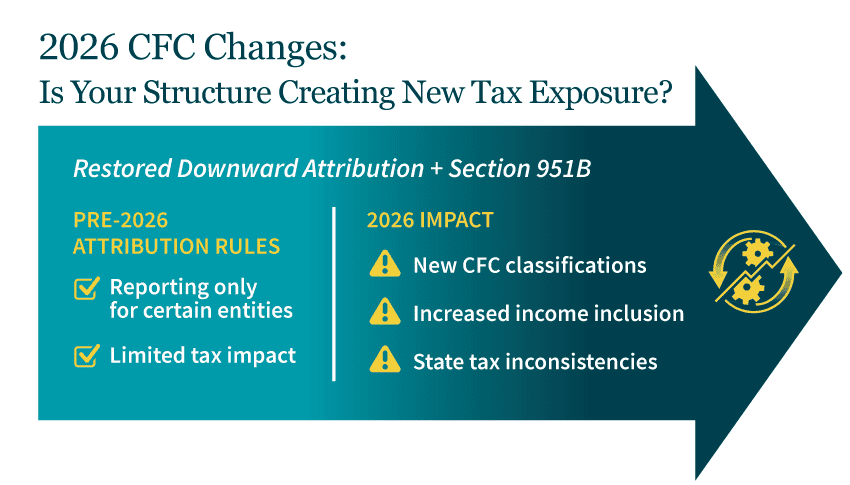
Restored downward attribution under Section 958(b)(4), combined with the introduction of Section 951B, changes how certain foreign entities are classified. For some businesses, the impact extends beyond reporting requirements. The revised rules may increase taxable income through Subpart F or Net CFC Tested Income (NCTI) — known pre-2026 as Global Intangible Low-Taxed Income, or GILTI — inclusions.
As you assess your 2026 tax position, understanding how these changes apply to your ownership structure is critical.
What Has Changed Under Section 951B
Before the Tax Cuts and Jobs Act (TCJA), the downward attribution rules prevented certain foreign corporations from being treated as controlled foreign corporations (CFCs) through constructive ownership. TCJA eliminated those rules, causing an increase in U.S. income tax compliance complexity for many multinational groups.
Beginning in 2026, the attribution rule under Section 958(b)(4) has been reinstated, once again blocking downward attribution from foreign persons. In addition, new Section 951B introduces a parallel inclusion regime applicable to certain entities — often referred to as “foreign controlled foreign corporations” (FCFC). Under this framework, certain foreign entities that may no longer qualify as traditional CFCs solely due to downward attribution may now generate income taxable to U.S. shareholders.
If your organization has foreign affiliates, foreign parent ownership, joint ventures, or private equity investment structures, the classification of those entities may now differ from prior years. The practical implication is not merely additional disclosure — it may affect how income flows into your U.S. tax base.
Why Structure Matters More in 2026
Ownership attribution rules can change how foreign corporations are viewed for U.S. income tax purposes, even when direct ownership percentages stay the same. Constructive ownership through related parties may trigger FCFC status where it did not exist previously.
For your business, that may result in Subpart F inclusions, NCTI inclusions, foreign tax credit limitations, and adjustments to your effective tax rate.
The impact depends heavily on your ownership chain, foreign effective tax rates, and interaction with other international provisions. There is no universal outcome. Two companies in similar industries may experience very different results depending on how their structures are organized.
This is why reviewing your global entity chart in 2026 is not optional. It is foundational.
The Multistate Dimension
Federal classification is only part of the equation. State conformity creates an added layer of required analysis.
Some states automatically adopt federal tax law changes. Others conform to the Internal Revenue Code as of a fixed date. Certain jurisdictions decouple from CFC or international inclusion rules altogether.
For your organization, this may produce inconsistencies — such as income included federally but excluded at the state level (or vice versa). It can also affect how unitary groups are defined and how apportionment factors are calculated. Some states have opined on how rules should be coordinated; many others are yet to provide guidance.
If you operate in multiple states, evaluating Section 951B exposure without simultaneous state and local tax (SALT) review may leave gaps in your analysis. The interaction between federal inclusion rules and state conformity positions can materially affect your overall tax liability.
Modeling Your 2026 Exposure
When assessing the impact of restored downward attribution, high-level assumptions are rarely sufficient. The rules interact with other international provisions, including NCTI calculations, foreign tax credits, and interest limitation rules.
Comprehensive modeling allows you to evaluate how these variables influence:
- Federal effective tax rate
- State tax exposure
- Cash tax obligations
- Earnings and profits calculations
Because these provisions operate together, analyzing them separately can produce incomplete conclusions. An integrated review provides clarity around whether your current structure stays aligned with your long-term tax strategy.
Strategic Considerations for 2026 and Beyond
Now that the rules are in effect, organizations should consider whether structural adjustments are appropriate. This may include reviewing ownership percentages, intercompany arrangements, or capitalization strategies.
In some cases, the current structure may remain despite new inclusion rules. In others, modest changes may reduce volatility in your effective tax rate. The path depends on your operational footprint, jurisdictional mix, and long-term growth strategy.
The most crucial step is obtaining a clear understanding of how Section 951B applies to your organization today. With that clarity, you can evaluate whether refinements are called for.
Looking Ahead
International tax policy continues to evolve, and structural classification rules play a significant role in determining taxable income. The reinstatement of downward attribution and the introduction of Section 951B reflect a broader focus on cross-border ownership transparency and income inclusion.
For CFOs and tax directors, the goal is not simply compliance. It’s maintaining visibility into how global operations influence your overall tax profile. In 2026, that visibility begins with a renewed evaluation of your CFC or FCFC exposure.
Navigating Section 951B and CFC Changes With MGO
MGO is a national accounting and consulting firm serving middle-market companies across manufacturing, life sciences, technology, cannabis, entertainment, and other globally active sectors. We provide international tax, corporate tax, and state and local tax services designed to align compliance requirements with strategic planning.
Our teams collaborate across federal and state disciplines to evaluate ownership attribution, assess Section 951B exposure, and model multistate implications. By integrating international tax and SALT analysis, we help you understand how structural changes affect your effective tax rate and long-term planning.
If your organization has foreign affiliates, now is a smart time to reassess your structure under the 2026 rules. Connect with MGO to assess how the reinstated attribution rules and new FCFC regime may affect your 2026 tax planning.