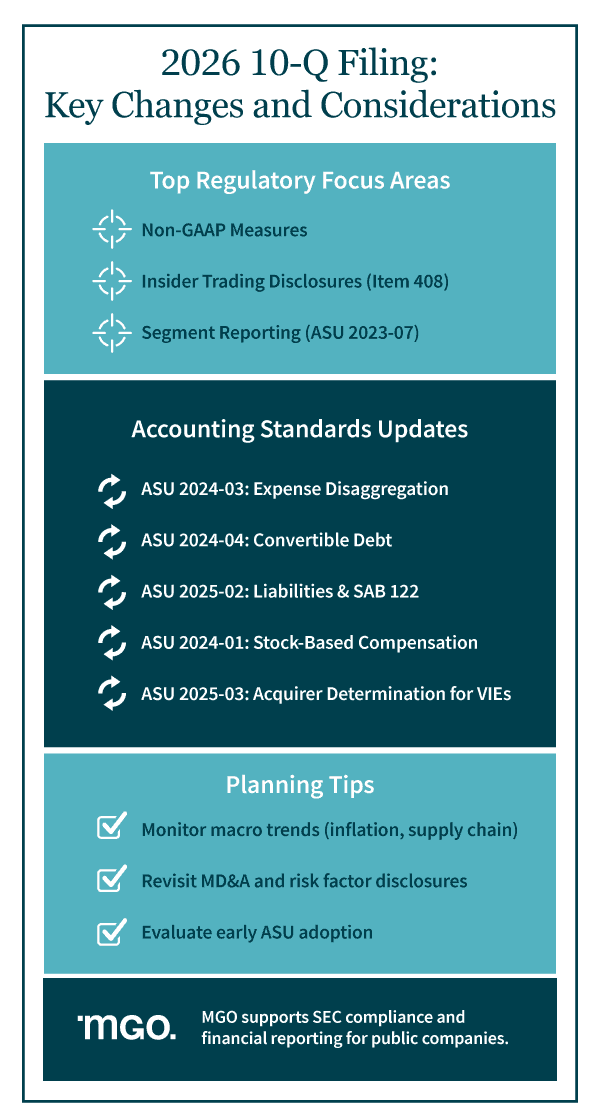
Key Takeaways:
- The 2026 10-Q filing season brings evolving SEC regulations, new FASB standards, and shifting economic pressures that may affect your disclosures.
- Reviewing macroeconomic trends, accounting updates, SEC commentary, and legal developments can help your business strengthen reporting accuracy and transparency.
- Staying organized with a proactive 10-Q readiness checklist helps support timely filings, compliance, and effective communication with investors.
—
Form 10-Q is still a cornerstone of quarterly financial reporting, offering stakeholders prompt insights into your organization’s performance, risks, and strategic developments. As the 2026 reporting season begins, the regulatory environment continues to evolve — bringing updates from the Securities and Exchange Commission (SEC), new accounting standards from the Financial Accounting Standards Board (FASB), and heightened audit focus driven by Public Company Accounting Oversight Board (PCAOB) inspection priorities.
This checklist provides a framework for finding areas that may affect your next 10-Q filing, helping your teams assess disclosure readiness and align internal controls accordingly.
Your 2026 10-Q Readiness Checklist
As you prepare your next quarterly filing, use this checklist to identify where your reporting processes, disclosures, and internal documentation may need refinement. Each section highlights actions your business can take to stay compliant, transparent, and ready for potential SEC scrutiny.
Heightened Economic Uncertainty and Disclosure Risk
Start by evaluating how the broader economic landscape could shape your upcoming 10-Q. Take the following actions as part of your review:
- Assess the impact of global and domestic economic factors: Examine how inflation, supply chain instability, tariffs, and currency fluctuations may influence operations and reporting.
- Incorporate commentary in the management discussion and analysis (MD&A) section: Discuss how these issues may affect future results to help provide context for investors.
- Benchmark against peers: Review competitor and industry disclosures to help refine your own risk factors.
- Consider early-stage note disclosures: These may be called for in instances where macroeconomic pressures affect estimates or assumptions used in financial statements.
New FASB Standards Affecting 10-Q Disclosures
Recent FASB guidance may have implications for your financial reporting. Consider the following updates during your next 10-Q preparation:
ASU 2024‑03 and 2025‑01
- Overview: Require disaggregation of certain income statement expenses (Topic 220) to provide more detailed presentation in the notes, breaking down categories such as employee compensation, depreciation, and cost of goods sold.
- Effective date: Annual periods beginning after December 15, 2026, for public business entities (PBEs); interim periods within those annual periods beginning after December 15, 2027. Early adoption is permitted.
ASU 2024‑04
- Overview: Addresses accounting for induced conversions of convertible debt, potentially impacting how financing transactions are reported and disclosed.
- Effective date: Annual periods beginning after December 15, 2025, with interim periods within. Early adoption is permitted.
ASU 2024‑01
- Overview: Provides clarity on stock-based compensation accounting for certain awards, including measurement and recognition criteria.
- Effective date: Annual periods beginning after December 15, 2024; interim periods within annual periods.
ASU 2025‑02
- Overview: Revises liability-related disclosures in light of SEC Staff Accounting Bulletin No. 122, including removal of prior guidance on obligations like safeguarding digital assets.
- Effective date: Effective immediately for SAB 122 rescission, retrospective application for annual periods beginning after December 15, 2024.
ASU 2025‑03
- Overview: Introduces guidance for determining the accounting acquirer in business combinations involving variable interest entities (VIEs), ensuring consistent acquirer determination criteria.
- Effective date: Annual periods beginning after December 15, 2026, including interim periods. Early adoption is permitted.
Each standard includes different effective dates and early adoption options, which your accounting and financial reporting teams should evaluate based on your entity type and filing timeline.
SEC Commentary and Disclosure Trends
The SEC continues to refine its focus on several key areas. For 2026, consider reviewing recent:
- Comment letters about revenue recognition and non-generally accepted accounting principles (GAAP) financial measures.
- Compliance and disclosure interpretations (C&DIs) on non-GAAP metrics presentation and calculation consistency.
- Guidance on Segment Reporting (ASU 2023-07), which emphasizes transparency in reporting internal decision-making structures.
- Guidance on Income Taxes (ASU 2023‑09), which enhances tax disclosure requirements — including rate reconciliation and cash taxes paid (relevant for interim periods).
- Guidance on Financial Instruments — Credit Losses (ASU 2025‑05), which updates credit loss measurement and related disclosures, impacting reporting for calendar-year 2026 interim periods.
- Guidance on Derivatives and Hedging and Revenue from Contracts with Customers (ASU 2025‑07), which clarifies scope of derivative and revenue reporting (and may influence note disclosures and interim reporting).
Also, keep in mind changes to climate-related disclosure expectations. While some rules are still under judicial review, other items — such as earlier COVID-19 and crypto market guidance — have been formally withdrawn.
Revisions to Regulation S-K, including those related to insider trading (Item 408), are also important for evaluating executive compensation and related-party disclosures.
PCAOB Inspection and Internal Controls
Under audit pressure, it’s critical to have evidence that each control works as intended. PCAOB inspectors note that merely signing off a review provides “little or no evidence” of a control’s effectiveness. Make sure controls over estimates and reconciliations are properly documented and tested. Validate that management review procedures include quantitative checks and that any deviations are investigated. Coordinate with auditors early to fix any internal control over finance reporting (ICFR) weaknesses before they become a comment.
Legal and Compliance Considerations
Several other developments may call for updates to your risk disclosures or governance commentary:
- Department of Justice (DOJ) guidance (July 2025) on unlawful discrimination and enforcement actions.
- CF Disclosure Guidance: Topic No. 2 (cybersecurity) was withdrawn, signaling a potential shift in expectations.
- Other withdrawn guidance includes those related to COVID-19 disclosures and digital assets.
Legal and compliance teams should coordinate with financial reporting personnel to confirm that any required updates are prompt and appropriately supported by internal documentation.
Key 10-Q Filing Deadlines for 2026
Staying on top of Form 10-Q deadlines is critical for aligning your internal review, audit procedures, and disclosure planning. Here are the SEC filing timelines based on filer status:
| Filer Type | Public Float | Deadline |
| Large Accelerated Filer | $700 million or more | 40 days after fiscal quarter-end |
| Accelerated Filer | $75 million to <$700 million | 40 days after fiscal quarter-end |
| Non-Accelerated Filer | Less than $75 million | 45 days after fiscal quarter-end |
For calendar-year companies, here are the 2026 filing deadlines:
| Quarter End | Large Accelerated / Accelerated | Non-Accelerated |
| March 31, 2026 (Q1 2026) | May 11, 2026 | May 15, 2026 |
| June 30, 2026 (Q2 2026) | August 9, 2026 | August 14, 2026 |
| September 30, 2026 (Q3 2026) | November 9, 2026 | November 14, 2026 |
Filing on time helps reduce regulatory risk and supports consistent investor communications. Consider working backwards from these deadlines to prove internal review milestones and maintain cross-functional alignment.
Supporting Your 10-Q Readiness and Reporting Goals
MGO serves as an independent auditor to publicly traded companies and those preparing for the capital markets, supporting Form 10-Q filings through quarterly review and audit-related procedures.
In our role as auditor, we assess how evolving accounting standards, SEC disclosure expectations, and emerging risks are reflected in your interim financial information. Our work includes risk-focused inquiries, analytical procedures, and review of disclosures to help flag areas that may warrant attention ahead of filing deadlines (you remain responsible for preparing your financial statements and disclosures).
Reach out to our team today to learn how we can support your next Form 10-Q filing.