
Key Takeaways:
- An ESOP-based independent buyout can provide cannabis business owners with an alternative to selling to a strategic or financial buyer.
- Owners may be able to achieve partial or full liquidity while preserving their company’s independence, culture, and leadership continuity.
- Depending on the business structure and transaction, ESOPs may offer tax advantages while creating an ownership opportunity for employees.
—
As the cannabis industry matures, you may be thinking more seriously about what comes next for the business you’ve built. Traditional mergers and acquisitions (M&A) remain an important exit option, but they aren’t necessarily the right fit for every owner or every market environment.
If you want liquidity without handing your company over to an outside buyer, an independent buyout through an Employee Stock Ownership Plan (ESOP) may be worth considering. An ESOP is a qualified retirement plan that can own shares of a company on behalf of its employees. This approach can provide a path to transition ownership while preserving your company’s independence, supporting employee ownership, and allowing you to remain involved on your terms.
Why Cannabis Owners Are Looking Beyond Traditional M&A
The cannabis M&A market has become more selective as capital availability, valuations, and industry conditions have evolved. For some owners, that has made it harder to sell at a price that reflects the long-term value they’ve built. But valuation isn’t the only consideration. You may also be thinking about the legacy you leave behind — what happens to your employees, brand, culture, and community after you step back from ownership.
You may want to:
- Take some money off the table without leaving the business immediately
- Preserve the culture and identity you’ve built
- Maintain relationships with employees, customers, and other stakeholders
- Gradually transition ownership rather than making a complete exit
- Create a succession plan that supports the company’s long-term independence
For some founders, the best exit strategy may not follow a traditional path. An ownership transition that generates liquidity while preserving independence is a possible alternative to match your financial goals with long-term stewardship.
Why a Traditional Sale Isn’t Always the Right Fit
A traditional sale can provide an attractive exit for owners seeking liquidity, and it may maximize value in certain situations. But the priorities of a financial buyer aren’t always the same as yours.
A third-party buyer may seek operational changes, cost reductions, leadership transitions, or a future resale of the company to generate a return within its investment horizon. Those strategies can make sense financially, but they may not align with the vision you have for your business.
If preserving your company’s culture, employee relationships, and community impact matters to you, an alternative ownership structure may deserve a closer look.
What Is an ESOP-Based Independent Buyout?
In an independent buyout, the ESOP purchases some or all the company’s stock, allowing you to receive liquidity while transferring ownership internally rather than selling to an outside acquirer.
The transaction can be structured as either a partial or full sale, depending on your goals and the company’s circumstances. Existing leadership may also remain in place, allowing the business to continue operating independently, and can participate in equity grants, if any.
That creates a fundamentally different ownership transition than a traditional sale:
- Traditional sale: You sell to an outside buyer, who takes ownership and determines the company’s future direction.
- Independent buyout: The ESOP becomes an owner on behalf of employees, while the company can maintain its existing leadership, culture, and independent operations.
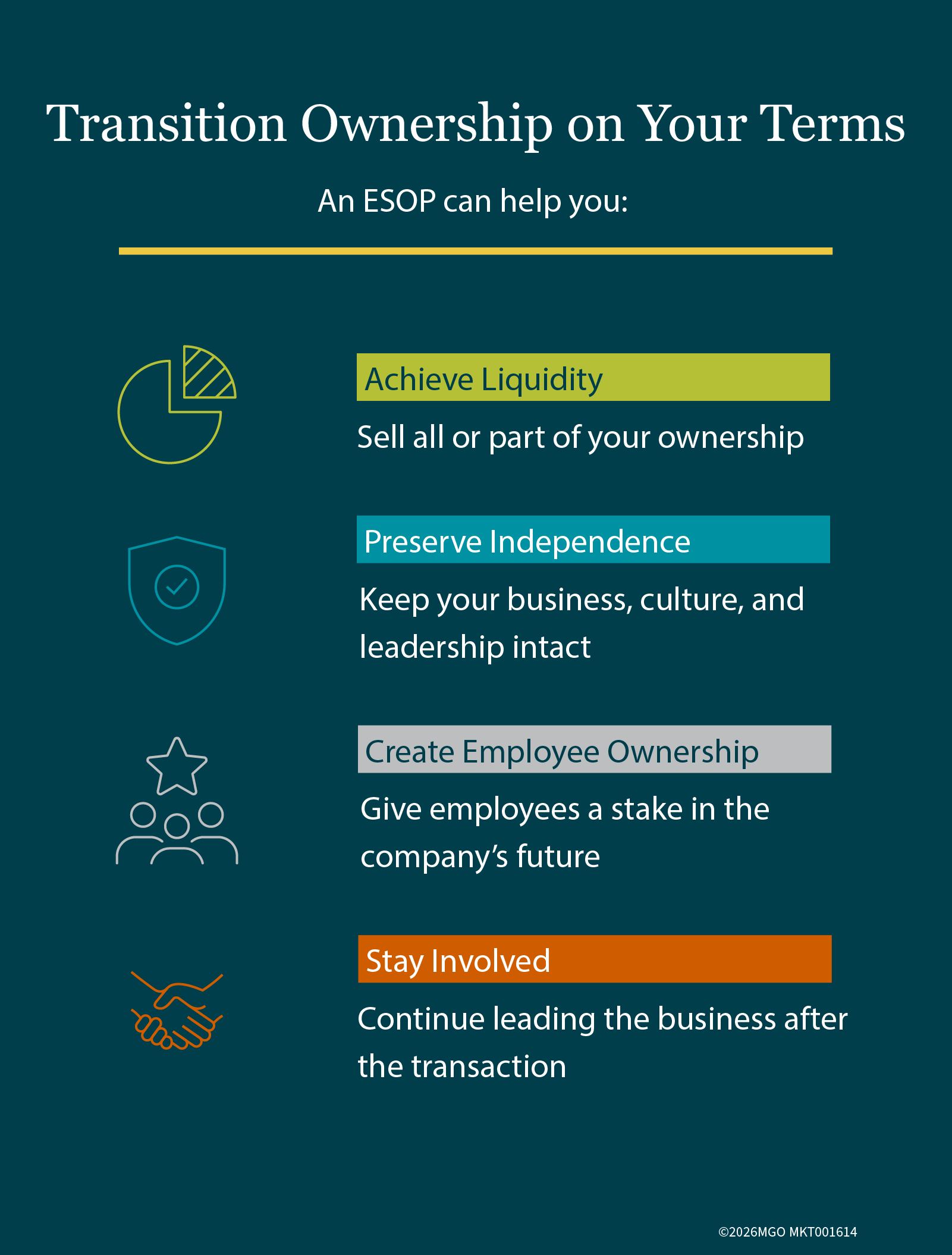
Potential Benefits of an Independent Buyout
Key benefits of independent buyouts for cannabis business owners include:
Liquidity and Ownership Flexibility
An ESOP transaction doesn’t necessarily mean walking away from your business. You may be able to sell a portion of your ownership, diversify your personal wealth, and remain active as an executive, director, or board chair.
Depending on the structure, you may also retain an economic interest in future growth through retained ownership, warrants, options, or other equity-linked arrangements. Seller notes with warrants can also be incorporated into some transaction structures.
This flexibility can make an ESOP attractive if you’re ready for liquidity but not ready to leave the company behind.
Preserving Independence and Legacy
An independent buyout can allow your company to remain independent rather than becoming part of a larger organization or investment portfolio.
That can help preserve the culture, brand, mission, and strategic direction you’ve spent years building. It can also provide continuity for employees, customers, suppliers, and other stakeholders.
For owners who see their business as more than an asset to be sold, that continuity can be an important part of the decision.
Creating Employee Ownership
With an ESOP, employees can participate in the company’s future through beneficial ownership.
Employee ownership can support engagement, retention, and organizational continuity by giving employees a direct financial interest in the business’s performance. It can also create an opportunity for employees to build retirement wealth through the value of their ESOP accounts.
For a founder who has spent years building a team, transferring ownership to employees can offer a different kind of legacy than selling to an outside investor.
Potential Tax Advantages
Tax considerations can be another important part of the ESOP analysis.
For example, owners of qualifying C corporations who sell at least 30% of their stock to an ESOP may be eligible for capital gains tax deferral under Section 1042 by reinvesting proceeds in qualified replacement property (QRP). Depending on the circumstances and future planning, the deferred gain may ultimately be avoided.
ESOP financing can also provide tax benefits to the company. Contributions used to repay ESOP acquisition debt are generally tax deductible, subject to applicable limitations and requirements.
For a 100% ESOP-owned S corporation, income attributable to the ESOP-owned shares generally is not subject to federal income tax. This can substantially improve company cash flow and help support the financing and ongoing operation of the business.
These benefits are highly dependent on the company’s tax structure, the transaction, and applicable requirements, so they should be evaluated as part of the initial planning process.
ESOPs Are Not Without Challenges
While ESOPs could offer significant advantages, they may not be appropriate for every company.
For example, owners should pay attention to:
- The need for independent valuation and fiduciary oversight
- Ongoing ESOP administration and compliance requirements
- Financing considerations and transaction affordability
- Employee communication and education requirements
- Cannabis-specific regulatory and licensing considerations
Running a feasibility study early in the process can help you determine whether an ESOP structure is both practical for your circumstances and in alignment with your long-term objectives.
Is an Independent Buyout the Right Fit for Your Cannabis Business?
An ESOP isn’t automatically the best exit strategy. The right approach depends on your goals, your company’s financial position, and the regulatory environment in which you operate.
Ownership and Succession Goals
Start by considering how you want ownership to change and what role you want to play afterward.
- How much liquidity do you want?
- Do you want to remain involved after the transaction?
- How important is preserving your company’s culture and independence?
- Are you interested in employee ownership?
- Would you prefer a gradual transition over a complete exit?
Financial Readiness
You’ll also need to evaluate whether your business is financially positioned for an ESOP transaction. This can include company performance, cash flow, valuation, financing capacity, and overall transaction feasibility.
Cannabis-Specific Considerations
For cannabis businesses, the analysis goes beyond traditional financial and tax considerations. Regulatory interpretations are one of the most critical factors in ESOP planning for cannabis companies. Licensing agencies may review ownership, control, and governance differently across various jurisdictions. And for multistate operators, varying requirements across states can add another layer of complexity to structuring and implementing transactions.
These issues can affect both the feasibility and timing of an independent buyout, making early engagement with legal, tax, valuation, and regulatory advisors particularly important to help identify potential obstacles before a transaction progresses too far.
How MGO Can Help
An independent buyout requires coordination across valuation, tax, accounting, transaction structure, financing, and regulatory considerations. MGO helps cannabis business owners evaluate ESOP-based buyouts and other ownership transition strategies by assessing tax implications, transaction readiness, financial reporting considerations, and business objectives.
MGO provides support across a range of considerations, including:
- Evaluating the tax implications of ownership transition strategies
- Assessing transaction readiness and financial reporting requirements
- Supporting valuation and due diligence efforts
- Reviewing accounting, governance, and compliance considerations
- Coordinating with a client’s legal and other advisors as appropriate
For owners seeking liquidity while preserving independence and long-term legacy, an ESOP-based independent buyout may be worth evaluating alongside other succession planning alternatives. Contact MGO to discuss how ownership transition strategies may align with your business, financial, and long-term goals.