
Key Takeaways:
- Selling an investment property can trigger capital gains, depreciation recapture, and state and local tax liabilities that affect your net proceeds.
- Before you sell, evaluate rents, leases, maintenance, financial performance, and records to identify opportunities to strengthen the property’s value and marketability.
- Depending on your goals, strategies such as 1031 exchanges, Delaware Statutory Trusts, Qualified Opportunity Zones, and installment sales may provide alternatives to an outright sale.
—
For many real estate investors, selling an investment property is the culmination of years of ownership and value creation. But deciding to sell is only the beginning. Once you decide to pursue a sale, an important question follows: What do you want to do with the proceeds?
You may want to cash out, diversify, pay down debt, or reinvest in another property. Starting the planning process before putting the property on the market can give you more options and a clearer picture of your potential net proceeds.
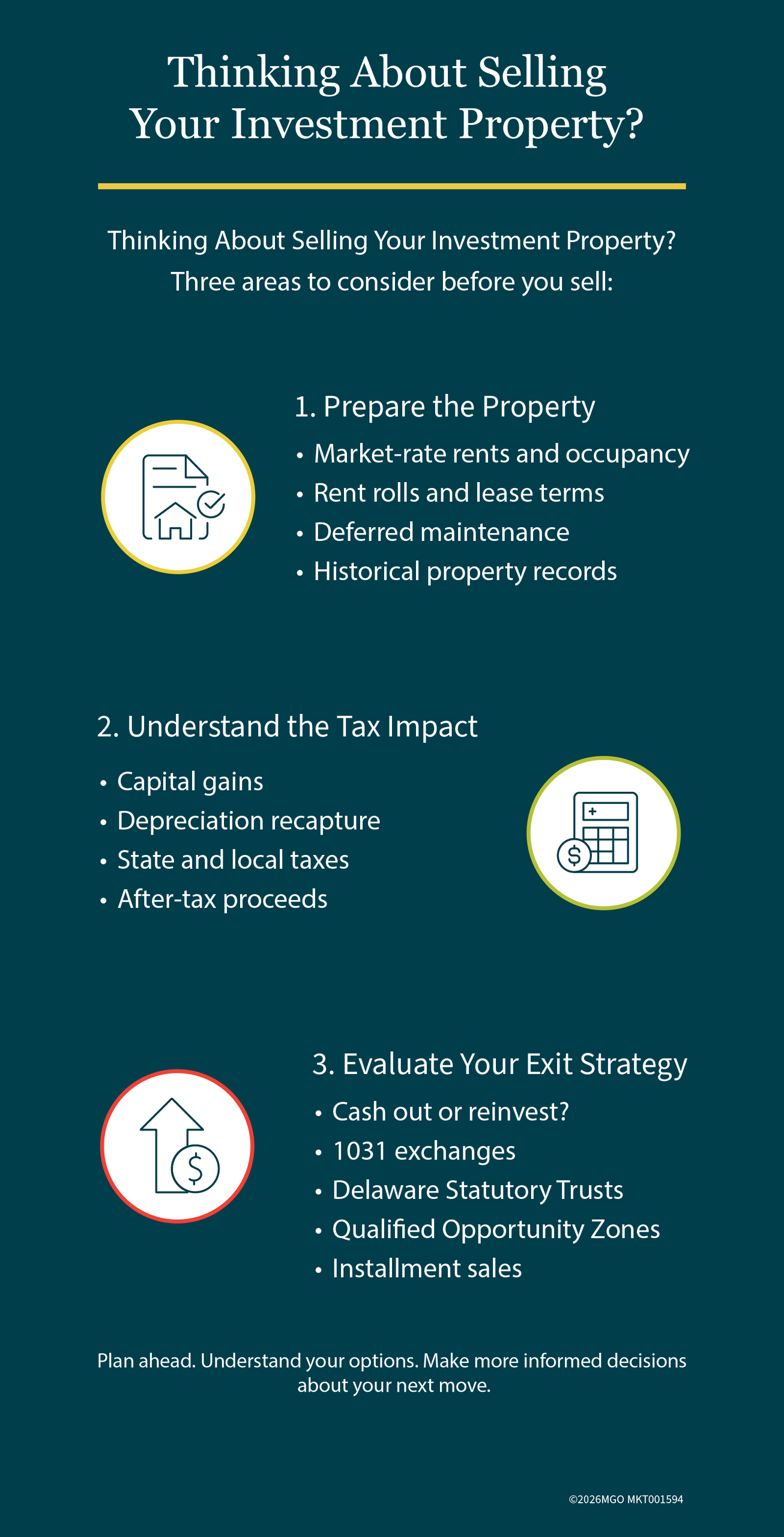
Start With the Property Itself
Before focusing on the transaction, evaluate the property from a buyer’s perspective. The condition and financial performance of an asset can have a significant effect on its marketability and selling price.
Review Rents, Leases, and Occupancy
Review current rents against comparable properties in the market. If rents are below market, consider whether there is an opportunity to increase them before a sale, taking into account existing lease terms, tenant relationships, and market conditions.
Your rent roll and lease agreements also give buyers insight into the property’s current and expected income. Consider tenant stability, lease expiration dates, renewal terms, and rent escalations.
A fully leased building with strong tenants and long-term leases may be more attractive to buyers — and potentially command a higher value — than a property with significant vacancy or below-market rents.
Address Deferred Maintenance
If the property has deferred maintenance or other physical issues, determine whether addressing them before going to market could improve its appeal and value.
Consider repairs, cleaning, landscaping, common-area updates, or other work that could affect a buyer’s perception of the asset. Also consider the tax treatment of repairs and improvements and whether certain expenses can be deducted before the sale. The goal isn’t necessarily to renovate everything, but to evaluate which improvements are likely to provide value.
Organize Historical Records
Gather documentation related to capital improvements, repairs, property taxes, leases, insurance, major contracts, and other significant property-level activity. These records can help support the property’s financial history and may also be relevant to determining your tax basis and calculating gain.
Selling a property is just one stage of the real estate investment lifecycle. Download The Real Estate Investor’s Lifecycle Playbook to explore how tax strategy, transaction advisory, audit, and consulting services can support smarter decisions at every stage of the investment journey — from pre-acquisition planning and acquisition through ownership, disposition, and reinvestment.
Understand the Tax Consequences Before You Sell
Once you have a better understanding of the property’s value and your objectives, evaluate what the sale could mean for your tax liability.
Capital Gains and Depreciation
When you sell an investment property for more than its adjusted tax basis, the transaction generally produces a taxable gain. Your adjusted basis can be affected by the property’s original purchase price, capital improvements, and depreciation claimed during ownership.
Depreciation deductions generally reduce your tax basis, which will increase the amount of gain recognized when the property is sold. As a result, your taxable gain may be greater than simply comparing the property’s original purchase price with its selling price.
For example, if you purchased a property for $1 million and claimed depreciation over several years, your adjusted basis could be substantially below the original purchase price. If you sell for $1.5 million, the taxable gain is generally calculated using the adjusted basis rather than the original purchase price.
The character and tax rate applicable to the gain can vary based on factors such as how long you have held the property and your ownership structure. Federal, state, and local taxes may also affect your ultimate liability.
Depreciation Recapture
Depreciation can provide valuable tax benefits during ownership, but it can also affect the tax treatment when you sell. Depending on the property and depreciation deductions claimed, some of the gain attributable to depreciation may be subject to depreciation recapture or taxed under special rules rather than at the preferential long-term capital gains rate.
This can be particularly important for investors who have used accelerated depreciation strategies or completed cost segregation studies.
The tax treatment of the gain may vary, with depreciation-related gain subject to recapture rules and the remaining gain potentially taxed at preferential capital gains rates. For properties that have generated substantial depreciation deductions in prior years, understanding this potential tax liability can be an important part of planning the sale.
Before selling, calculate your adjusted basis, estimated gain, and potential depreciation-related tax liability to get a more realistic view of your after-tax proceeds.
State and Local Tax Considerations
State and local taxes can also affect the proceeds from a property sale. Not all states impose a separate capital gains tax, but gains from the sale of real property may still have state income tax implications depending on where the property is located and other factors.
Investors who own property in multiple jurisdictions may also face different tax rates, filing requirements, nonresident considerations, or withholding obligations.
Decide What to Do With the Proceeds
With the property’s value and potential tax consequences in view, consider your broader investment objectives. Do you want liquidity, diversification, continued real estate exposure, or tax deferral? Your answers can help determine which exit strategy is worth considering.
1031 Exchanges
A Section 1031 exchange allows investors to defer recognition of certain gains when proceeds from the sale of qualifying real property are reinvested in qualifying replacement property.
A 1031 exchange can be useful when you want to remain invested in real estate while changing properties or markets. Strict identification and timing requirements apply, so evaluate the exchange before the sale is structured and closed.
Delaware Statutory Trusts
A Delaware Statutory Trust (DST) allows investors to acquire a beneficial interest in professionally managed real estate. In certain circumstances, DST interests may qualify as replacement property in a 1031 exchange.
A DST may appeal to investors seeking a more passive ownership structure, but you should also consider the trade-offs — including reduced control over the property, potential liquidity constraints, and the timing of distributions.
Qualified Opportunity Zones
Qualified Opportunity Zone investments may provide certain tax benefits when applicable requirements are met. For investors with significant gains, a Qualified Opportunity Zone investment can be evaluated alongside other options, although specific eligibility and holding-period requirements apply.
Installment Sales
An installment sale may allow eligible sellers to recognize certain gain over multiple years as payments are received rather than recognizing all of the gain in the year of sale. This can provide flexibility in managing taxable income and cash flow, but receiving payments over time introduces credit and collection considerations.
Consider the Bigger Investment Picture
Selling an investment property is more than a transaction. It is a decision about where your capital goes next. Starting early can help you evaluate the property’s marketability, address issues that could affect its value, understand your potential tax liability and determine whether cashing out or reinvesting better aligns with your goals.
Taking a comprehensive view of the disposition process can help you make more informed decisions about the next stage of your investment strategy. MGO’s Real Estate team can help you evaluate the tax implications of a sale and develop a strategy for managing and reinvesting your proceeds based on your broader financial goals.
Reach out to our team today to discuss your investment property disposition and tax planning needs.