
Key Takeaways:
- Single Audits are triggered when a non-federal entity expends $1 million or more in federal awards during its fiscal year, with the threshold based on federal awards expended rather than cash received.
- Federal award audits evaluate financial reporting, internal controls, compliance, and corrective actions, making audit readiness a critical part of managing funding risk and organizational oversight.
- Proactive preparation, internal risk assessments, and timely remediation of findings can help agencies, recipients, and subrecipients reduce compliance issues and protect future federal funding.
—
Federal award audit requirements are more than a compliance exercise. They’re a cornerstone of public trust, ensuring taxpayer dollars are used as intended. As federal oversight continues to intensify, understanding audit requirements — and how to prepare for one — is critical to maintaining compliance and protecting future funding opportunities.
Whether your organization receives funding directly from a federal agency or indirectly as a subrecipient, a proactive, risk‑based approach to audit readiness can reduce disruption, limit findings, and protect long‑term access to federal funding.
This article breaks down the fundamentals of federal award audits — from audit triggers to preparation strategies — for anyone new to federal funding or experienced organizations looking to brush up on the basics.
Understanding the Federal Award Landscape
The federal government delivers programs and procures services through three primary instruments: contracts, grants, and cooperative agreements. While they may appear similar operationally, they carry different audit and compliance expectations.
Contracts
Contracts are used when the government purchases goods or services for its own use. Contractors typically operate under defined scopes of work, may earn profit, and are generally not subject to Single Audit requirements. That said, contractors remain subject to contractual compliance requirements and oversight from awarding agencies and Inspectors General, particularly in areas such as cost allowability, billing practices, and performance.
Grants and Cooperative Agreements
Grants and cooperative agreements, by contrast, are forms of federal financial assistance. They are designed to support public‑purpose programs, such as housing assistance, workforce development, public health initiatives, or infrastructure investment. These awards carry heightened accountability requirements, prohibit profit, and trigger compliance audits once expenditure thresholds are met.
Understanding how an award is classified, and how that classification affects audit obligations, is a foundational compliance responsibility for agencies, recipients, and subrecipients alike.
When a Federal Audit Is Triggered
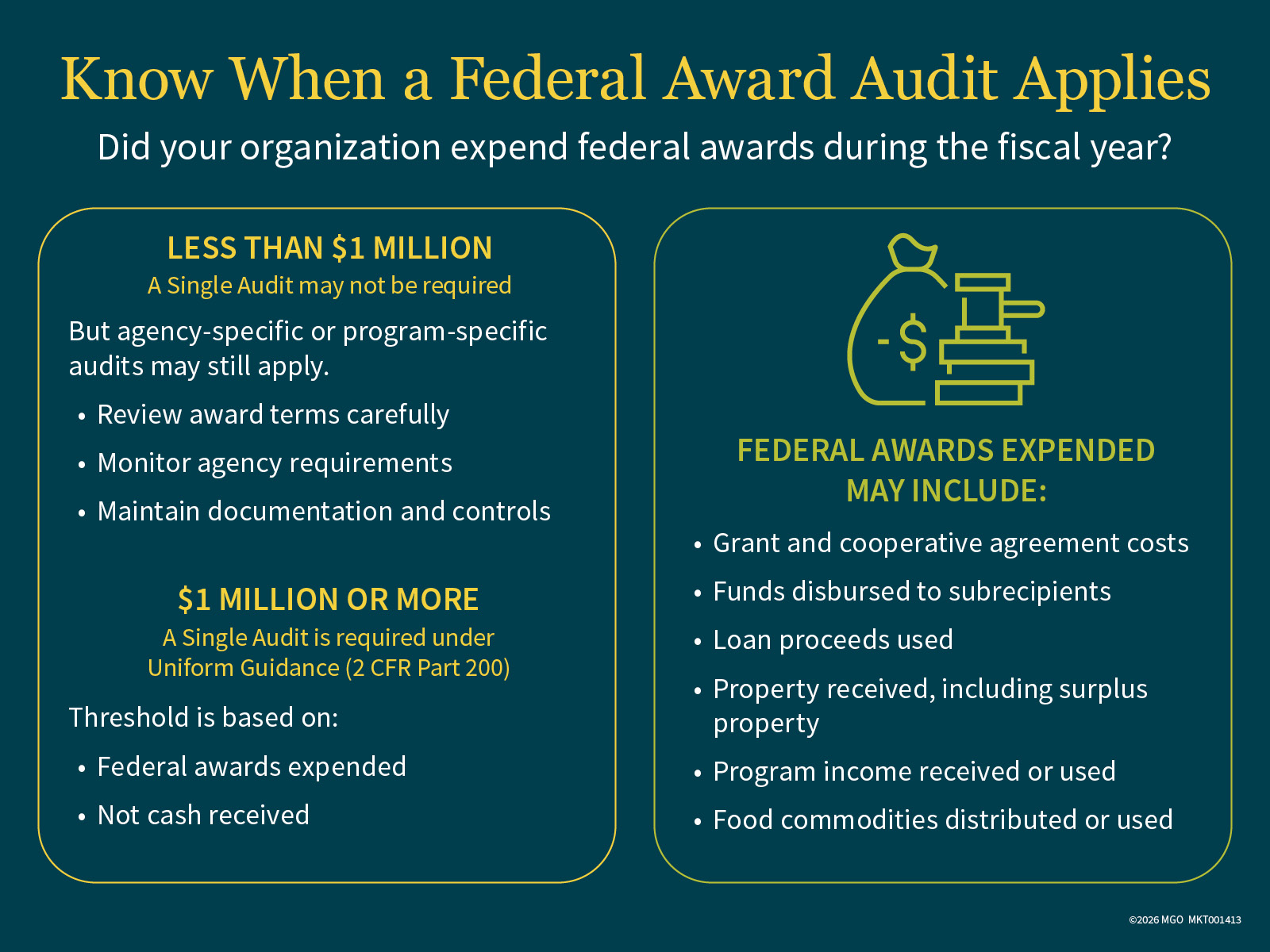
The most common audit applicable to federal financial assistance is the Single Audit, governed by Subpart F of the Uniform Guidance (2 CFR Part 200). A Single Audit is required when a non‑federal entity expends $1 million or more in federal awards during its fiscal year.
A critical and often misunderstood point is that the threshold is based on federal awards expended, not cash received.
Federal awards expended may include:
- Expenditure or expense transactions under grants, cooperative agreements, and cost‑reimbursement contracts
- Funds disbursed to subrecipients
- Use of loan proceeds under federal loan and loan guarantee programs
- Receipt of property, including surplus property
- Receipt or use of program income
- Distribution or use of food commodities
- Interest subsidy amounts disbursed
Entities that fall below the Single Audit threshold are not necessarily exempt from audit oversight. Program‑specific or agency‑specific audits may still apply, depending on award terms and federal agency requirements
Misinterpreting thresholds, award types, or expenditure calculations is a common — and avoidable — source of compliance risk.
Download our free e-book, How to Prepare for a Successful Single Audit, for practical guidance to strengthen controls and avoid common pitfalls.
What a Single Audit Covers
A Single Audit is a comprehensive engagement that extends well beyond a review of one program or grant. It typically includes:
- Entity‑wide financial statements
- A Schedule of Expenditures of Federal Awards (SEFA) — summarizes all federal awards expended during the fiscal year and serves as the foundation for determining major programs subject to audit
- Internal control over financial reporting
- Internal control over compliance
- Compliance testing for each major federal program
- Follow up on prior audit findings
- Submission of the Data Collection Form to the Federal Audit Clearinghouse
- Submission of the audit reporting package to non-federal grantors and other regulatory agencies as applicable
The resulting audit reporting package directly influences how federal agencies and pass‑through entities assess organizational risk. Patterns of findings, weak controls, or delayed remediation can result in increased oversight, special award conditions, or funding restrictions.
Preparing for a Federal Award Audit
Once an audit becomes likely, preparation should begin well before fieldwork starts. Effective preparation generally focuses on three areas: auditor procurement, pre‑audit readiness, and internal risk assessment.
Auditor Procurement
Non‑federal entities are responsible for procuring their audit firm, and that procurement must comply with Uniform Guidance requirements. While cost is a factor, organizations should also evaluate:
- Federal award and Single Audit experience
- Staff qualifications and continuity
- Peer review results and quality history
- Independence and conflict‑of‑interest considerations
For example, an auditor that prepares an organization’s indirect cost rate proposal generally cannot perform its single audit (2CFR 200.509(b)).
Pre‑Audit Readiness
One of the most effective risk‑mitigation strategies is conducting a pre‑audit readiness assessment, a structured evaluation of what auditors are likely to test.
Think of the Single Audit as an open-book test. The Office of Management and Budget (OMB) Compliance Supplement provides a roadmap for this process, outlining the compliance requirements and audit procedures auditors may apply to specific federal programs. This framework auditors use is largely available in advance, so auditees should review the Supplement for their programs and use it to guide their readiness efforts.
Common readiness activities include:
- Reviewing financial statements and the SEFA for accuracy and completeness
- Assessing the design and operation of internal controls
- Reviewing the applicable sections of the OMB Compliance Supplement to identify key compliance requirements and areas auditors are likely to examine
- Testing compliance requirements on a sample basis
- Verifying corrective actions from prior audit findings
Addressing issues at this stage is significantly less disruptive — and less costly — than responding to findings after they are formally issued.
Internal Risk Assessment
While auditors are required to perform risk assessments, organizations benefit from conducting their own. Key risk indicators may include:
- Changes in laws, regulations, or agency guidance
- Staff turnover or organizational restructuring
- Prior audit findings or management letter comments
- Increased reliance on subrecipients or third‑party administrators
A disciplined risk assessment allows leadership to focus resources on the programs and processes that matter most.
Responding to Audit Findings
Even strong compliance programs may result in audit findings. The differentiator is not whether findings occur, but how they are addressed.
Audit findings influence future funding decisions, monitoring intensity, and agency confidence. Findings related to internal control deficiencies are particularly impactful, as they often signal broader governance or oversight concerns. Repeat findings often receive heightened scrutiny because they may indicate ineffective corrective actions or persistent control deficiencies.
Certain matters must be reported, including:
- Material weaknesses or significant deficiencies in internal control
- Material noncompliance
- Questioned costs exceeding $25,000
- Known or likely fraud
- Misrepresentation of corrective action on prior findings
Each finding includes defined elements — criteria, condition, cause, effect, questioned costs, and recommendations — followed by management’s response and corrective action plan.
From Findings to Sustainable Remediation
Effective remediation begins before the audit report is finalized. When a potential finding is identified, organizations should:
- Obtain the draft finding in writing
- Confirm the issue is within audit scope
- Validate the applicable criteria and factual condition
- Understand why the issue rises to a reportable level
- Seek clarification or negotiate wording when appropriate
- Develop a realistic, well‑documented corrective action plan
Corrective actions should be practical, measurable, and supported by updated policies, training, or controls. Just as important, they should be documented — future audits will assess whether remediation was implemented and sustained.
Taking a Proactive View of Compliance
Federal award audits are increasingly used as indicators of organizational maturity, governance strength, and funding risk — not just historical compliance.
Agencies, recipients, and subrecipients that treat compliance as an ongoing operational discipline are better positioned to reduce questioned costs, minimize repeat findings, strengthen relationships with funding agencies, and preserve and expand access to federal funding.
In an environment of heightened scrutiny, audit readiness is no longer a back‑office function. It is a strategic imperative.
How MGO Can Help
Our dedicated State and Local Government team provides Single Audit services tailored to government entities and other organizations receiving federal funding. We deliver an independent, objective assessment of your compliance with federal requirements, helping you identify risks early, strengthen internal controls, and prepare for audit requirements with confidence.
Whether you are navigating a first-time Single Audit or managing ongoing federal funding compliance, our team helps you approach the process with clarity and consistency. Reach out to our team to learn how we can support your federal award audit readiness and compliance needs.