
Key Takeaways:
- California businesses must now complete annual, independent cybersecurity audits to meet California Privacy Rights Act requirements.
- Cybersecurity audits must include documentation of technical and organizational controls, identification of potential risks, and a plan for remediation.
- Non-compliance can result in fines of up to $7,988 per violation, with enforcement already underway.
—
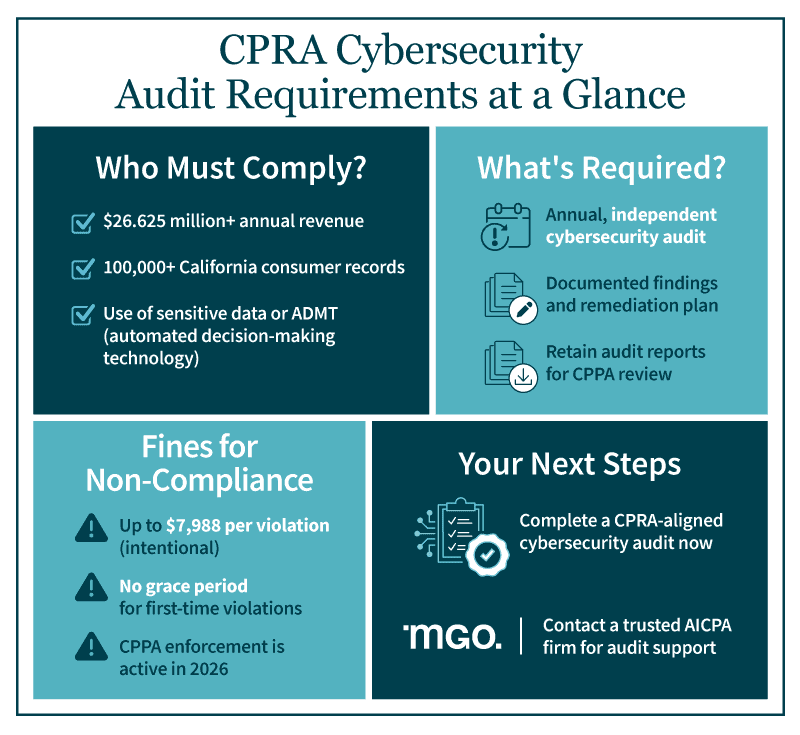
As of January 1, 2026, the California Privacy Rights Act (CPRA) requires certain businesses to complete annual, independent cybersecurity audits. The obligation applies to organizations that meet specific thresholds, including those with over $26.625 million in annual gross revenue or those that collect personal information from more than 100,000 California consumers/households.
These changes are not theoretical; they are active, enforceable regulations under California law — and enforcement is already underway.
This article outlines what these new audit requirements involve, what’s at stake for organizations subject to them, and how to approach compliance in a way that meets both regulatory expectations and operational realities.
Background: CPRA Cybersecurity Audit Requirements
The CPRA, which amends and extends the original California Consumer Privacy Act (CCPA), introduces new and more stringent obligations for businesses that collect, process, or share personal information about California residents.
Among the most significant changes effective January 1, 2026, is the requirement for annual cybersecurity audits for businesses whose processing of consumers’ personal information presents significant risk to consumers’ security.
A business’s processing presents significant risk to consumers’ security if any of the following is true:
- Processing 250,000 or more personal information records when the business had over $26.625 million in gross revenue in the preceding calendar year
- Processing 50,000 or more sensitive personal information records when the business had over $26.625 million in gross revenue in the preceding calendar year
- Deriving 50% or more of annual revenue from selling or sharing personal information
According to Article 9 of the statute, organizations that meet these criteria must now:
- Engage an independent party to conduct the cybersecurity audit
- Document the technical and organizational controls in place to protect personal data
- Show potential security risks and outline planned or completed remediation steps
- Maintain all audit records for inspection by the California Privacy Protection Agency (CPPA), if requested
What This Means for Your Business
Even though the first formal CPRA audit certifications are phased-in based on business size (2028–2030), the underlying obligations are enforceable starting January 1, 2026. This means that regulators can impose fines immediately if your organization fails to comply with the cybersecurity and privacy requirements, regardless of when your first certification is due.
Here’s how the phased audit deadlines break down:
- April 1, 2028: Businesses with over $100 million in annual gross revenue in 2026
- April 1, 2029: Businesses with $50 million–$100 million gross revenue in 2027
- April 1, 2030: Businesses with under $50 million gross revenue in 2028
In other words, while your first formal submission may not be due for several years, you are already required to implement reasonable cybersecurity practices and maintain audit-ready documentation in 2026.
The bottom line for your business:
- Fines are now active: Fines range from $2,663 to $7,988 per violation, with no grace period for first-time offenders. Each consumer record involved in a violation can trigger a separate fine.
- CPPA enforcement has teeth: The newly formed CPPA has full authority to audit your compliance — and it’s already begun issuing inquiries and notices.
- Audit defensibility is critical: Regulators are looking for more than boilerplate reports. Your cybersecurity audit must be thorough, independent, and provide a clear plan for risk mitigation.
How to Respond to CPRA’s Cybersecurity Audit Mandate
California’s privacy law now holds businesses to a higher standard of accountability. If your organization meets CPRA thresholds, the requirement for annual, independent cybersecurity audits is active — and failure to comply can result in regulatory penalties and reputational fallout.
To meet your obligations under the law and strengthen consumer trust, business leaders should prioritize several key actions:
- Engage an independent audit partner to conduct a cybersecurity audit aligned with the CPRA statute. This includes finding technical and organizational controls, documenting findings, and outlining areas that need attention.
- Clarify internal ownership of privacy risks. Cybersecurity is no longer the sole domain of IT. Finance, compliance, legal, and executive teams all have a role in understanding how personal data is used and protected.
- Develop a repeatable approach to compliance. Because audits must be conducted annually, now is the time to establish a repeatable framework that enables the organization to monitor risks, document improvements, and prepare for potential regulatory review.
These aren’t one-time requirements. They are a shift toward an operational model where privacy and security are continuous functions — not reactive in checkboxes.
A More Strategic Approach to Privacy Risk
Many organizations are still evaluating how best to meet their new obligations. Those with limited internal capacity or complex data ecosystems may receive help from outside support — particularly when it comes to conducting audits that meet both the technical and governance expectations of the law.
At MGO, we take an independent, risk-informed approach to these assessments. Our role isn’t just to evaluate; it’s to help your organization build a stronger position — one grounded in documentation, transparency, and control over your data environment.
We work across industries — including technology, manufacturing, and cannabis — and understand the nuances that shape each sector’s risk profile. We apply that insight to deliver audits that hold up to regulatory scrutiny and support long-term readiness.
Next Steps for Your Organization
If your business has not completed a CPRA-compliant cybersecurity audit, or if your current audit lacks the documentation required by the statute, it’s important to act.
Start by asking:
- Have we completed a documented cybersecurity audit that aligns with CPRA Article 9?
- Do we have a clear record of findings and remediation actions?
- Are we prepared to repeat this process annually?
If these questions raise concerns or uncertainties, now is the right time to speak with an advisor.
Reach out to our team today to begin a confidential discussion about where your business stands — and what steps can bring your cybersecurity audit program into full compliance.